You open the feed room door at 6 a.m. and stare at three bags of grain, two bales of hay, and a supplement shelf that looks like a pharmacy. Somewhere in that pile is the exact caloric balance your horse needs today. Get it right and you build a horse that holds condition, recovers from work, and lives longer. Get it wrong and you invite colic, laminitis, behavioral swings, or a quiet decline no one notices until the ribs appear.
Most owners guess. A 2006 study published in the Equine Veterinary Journal found that more than half of leisure horses in developed countries were overweight, and large scale follow up surveys since have confirmed the trend is getting worse, not better. The common cause is not cruelty. It is miscalculated caloric intake driven by bag labels, outdated advice, and the one scoop fits all assumption that still dominates most barns across North America and Europe.
This guide gives you a repeatable method to choose the right calories for your horse, grounded in numbers, body condition, and real world feeding. It is the same method used by equine nutrition professionals when they walk into a new barn and assess every horse in 30 minutes. Once you learn it, you will never look at a feed bag the same way again. You will learn how to calculate your horse’s baseline energy need, evaluate feed quality beyond the marketing tag, score body condition like a vet, fine tune the ration through the seasons, and know when to bring in a professional for complex cases. By the end, you will know exactly what goes in the bucket and why every pound matters.
Here is the bigger picture. Calorie management is the thread that connects every other part of equine care. A horse fed correctly recovers faster from work, holds muscle through the off season, resists laminitis triggers, and shows fewer behavioral issues under saddle. A horse fed incorrectly will never reach its potential no matter how skilled the training or how refined the veterinary care. That is why nutrition consultants routinely call calorie planning the single highest leverage decision an owner makes every season. It shapes weight, immune function, hoof growth, dental wear, fertility, longevity, and how the horse feels to ride on any given Saturday morning. Get the ration right and the rest of the training program begins to work the way the rider imagined it would.
Key Takeaways
- Calories in horses are measured in megacalories of digestible energy, not scoops.
- Age, weight, workload, and metabolism set the daily calorie target.
- Forage quality matters more than concentrate quantity in almost every ration.
- The Henneke Body Condition Score is the best real world measure of calorie balance.
- Diet changes must be gradual and reviewed against condition every 14 to 21 days.
Understanding Calories in Equine Nutrition
Before you choose the right calories for your horse, you need to know what a calorie actually is in equine terms. The gap between a human calorie label on a cereal box and the equine calorie metric is wider than most new owners expect.
Calories in horse nutrition are expressed as megacalories of digestible energy, written as Mcal DE. One megacalorie equals 1,000 kilocalories. This is the standard set by the National Research Council’s Nutrient Requirements of Horses, the reference used by vets, feed manufacturers, and extension programs worldwide.
Here is the baseline. A healthy 500 kilogram (about 1,100 pound) adult horse in light work needs roughly 20 to 25 Mcal DE per day. A retired pasture companion may need 16 Mcal DE. A three day event horse in peak training may need 33 Mcal DE or more. A lactating broodmare can push 30 Mcal DE. Temperature, breed, and temperament move these numbers further, which is why scoop feeding almost always misses the target.
Digestible energy comes from four nutrient classes, each behaving differently once swallowed:
- Structural carbohydrates, meaning fiber from hay and pasture, ferment slowly in the hindgut and deliver steady energy without blood sugar spikes.
- Non structural carbohydrates, meaning starch and sugar from grain, hit the small intestine fast and spike blood glucose.
- Fats and oils pack the highest calorie density and produce a calm, cool type of energy ideal for work.
- Protein repairs tissue and supports muscle development but is not an efficient fuel source for exercise.
Think of these categories like different grades of fuel. Fiber is the slow burning log in the fireplace. Starch is kindling that flares and fades. Fat is lighter fluid with patience. Protein is the structural timber of the building itself. Most horses need a ration anchored in fiber, accented with fat, and limited in starch.
Calories also require water. A horse drinks 5 to 15 gallons per day, and forage digestion cannot proceed without it. Dehydration lowers digestive efficiency and leads to impaction colic. A feeding program that nails calorie math but ignores water is still a failing program.
Digestibility declines with age, illness, and dental compromise. A 22 year old with worn molars may extract only 70 percent of the calories from the same hay a healthy eight year old extracts 90 percent from. This is why two horses on the same ration can look completely different after six months. It also explains why senior horses often need 10 to 20 percent more calories than their younger counterparts at the same workload, even though they are moving less. The calories are being offered but fewer are being absorbed, so the ration must be denser to compensate.
How to Choose the Right Calories for Your Horse
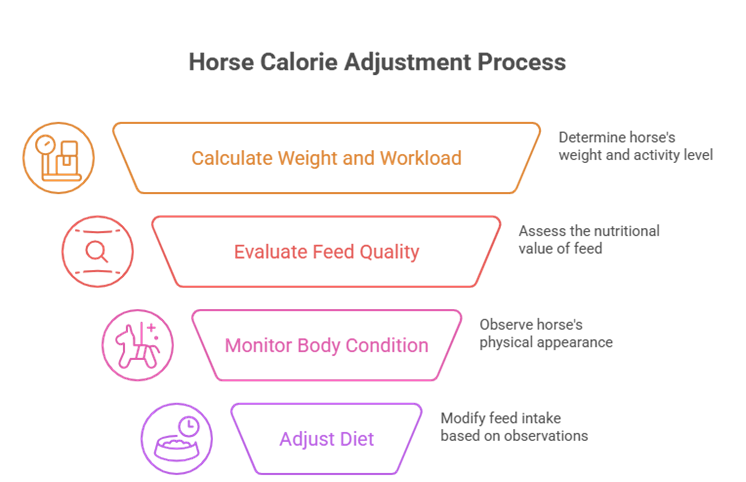
Choosing the right calories for your horse is a five step diagnostic process. Run it at least twice a year, and every time training, season, or health changes.
Identify Your Horse’s Needs
Start with the horse in front of you, not the feed label.
A horse’s nutritional needs are shaped by life stage, reproductive status, workload, health conditions, and temperament. A senior gelding who trails twice a week needs a completely different ration than a lactating broodmare or a two year old in early training.
Quick case. Two 500 kg Thoroughbreds can sit side by side with nearly identical work and need rations that differ by 20 percent. One is a nervous weaver who burns calories standing still; the other dozes on cross ties. The ration follows the horse, not the stall number.
A second illustration. Two easy keeping Haflingers on the same pasture can have completely different insulin profiles. One tolerates a small daily grain ration; the other develops laminitis from the same feed. The difference is the individual metabolism.
Write down every relevant fact: age, weight, sex, breed, discipline, weekly work schedule, diagnosed conditions, medications, supplements, turnout hours, pasture quality, and typical weather exposure. This written profile becomes the foundation of the ration plan.
Then answer three clarifying questions:
- Is the horse at an ideal body condition now
- Is the horse performing at the level you expect
- Is the horse maintaining that state without health issues
If any answer is no, the ration needs work. Calories are the lever that moves every one of those outcomes. A fourth practical tip: weigh the horse on the same day of the week at the same time of day whenever possible. Body weight naturally fluctuates 10 to 20 pounds through a normal 24 hour cycle based on gut fill, hydration, and manure output, and consistent timing strips that noise from the data.
Consider Age, Weight, and Activity Level
With the horse’s profile on paper, translate it into numbers.
Age matters because metabolism shifts across the lifespan. Foals and weanlings have high energy needs per kilogram because they are building tissue fast. Yearlings and two year olds stay energy hungry until mature height is reached. Adult horses from five to fifteen sit in a predictable maintenance band. Seniors, usually 18 and older, lose digestive efficiency and often need calorie dense, easier to chew feeds like soaked pellets, beet pulp, or senior formulas.
Weight is the base multiplier. The NRC equation for maintenance digestible energy is:
Maintenance Mcal DE per day = 0.0333 x bodyweight in kilograms
Worked example: a 500 kg horse. Multiply 0.0333 by 500 and you get 16.65 Mcal DE for maintenance, meaning the horse standing still in a field.
If you do not know the horse’s weight, a weight tape provides a reasonable estimate. The girth based formula is:
Weight in pounds = (heart girth in inches squared x body length in inches) divided by 330
Convert pounds to kilograms by dividing by 2.2. Weight tape estimates run within 5 to 10 percent of true weight. For accuracy, combine the tape with a livestock scale visit every six months.
Now add workload on top of maintenance:
- Light work (1 to 3 hours per week): add 20 percent
- Moderate work (3 to 5 hours per week): add 40 percent
- Heavy work (4 to 6 hours per week): add 60 percent
- Very heavy work (racing, endurance): add 90 percent or more
For our 500 kg horse in moderate work, that is 16.65 x 1.4, or roughly 23.3 Mcal DE daily.
A high strung Thoroughbred may need 10 to 15 percent more. An easy keeping Quarter Horse may need 10 to 15 percent less. Gestating mares in the last trimester need 10 to 20 percent extra. Lactating mares need as much as 80 percent above maintenance.
Evaluate Feed Quality and Type
Calories are not interchangeable. A megacalorie from leafy alfalfa behaves nothing like a megacalorie from corn.
Forage should provide at least 60 percent of daily calories in most horses, and closer to 100 percent in easy keepers and metabolic horses. The equine gut evolved to ferment fiber, and adequate forage prevents gastric ulcers, stereotypies, and colic. Common hays include timothy, orchardgrass, brome, bermuda, and alfalfa. Grass hays sit lower in calories; alfalfa sits higher and suits growing or lactating horses.
Evaluate forage on four criteria:
- Crude protein content (8 to 12 percent for grass hay, 16 to 20 percent for alfalfa)
- Calcium to phosphorus ratio (ideally 1.5 to 1)
- Non structural carbohydrate percentage (under 12 percent for metabolic horses)
- Digestible energy per kilogram
A forage test from a reputable lab costs 30 to 60 USD and is the single highest return investment in equine nutrition. Equi Analytical Labs and Dairy One both offer horse specific panels.
Concentrates belong in the ration only when forage cannot meet caloric demand. Better modern concentrates use controlled starch formulas with added fat sources like flaxseed, rice bran, or soybean oil. Look for low starch, controlled carb, or senior on the tag for metabolic or older horses. Avoid sweet feed mixes heavy in molasses and cracked corn unless directed by a vet.
Fat is the most calorie dense source available, about 2.25 times the energy of the same weight of carbohydrate. A quarter cup of quality vegetable oil delivers roughly 500 kilocalories with no starch load. For hard keepers, fat is the cleanest way to add calories without the behavioral spikes of grain.
Read the tag, not the marketing. Check guaranteed analysis values, watch for split grain listings, and confirm date of manufacture. Store grain in sealed metal containers; plastic bins invite rodents. Processed feed formats matter as well. Pellets deliver consistent intake but can be eaten quickly and may contribute to gastric discomfort if not paired with forage. Extruded feeds are expanded with heat and pressure, improving digestibility for seniors and horses with dental issues. Textured sweet feeds offer palatability but are usually too high in soluble sugars for metabolic horses. Match the format to the horse’s physiological state, not marketing claims on the bag.
Monitor Body Condition Score
The Henneke Body Condition Score, developed by Don Henneke at Texas A&M in 1983, remains the single most reliable real world tool for evaluating caloric balance.
The scale runs from 1 (emaciated) to 9 (extremely fat). Most healthy horses sit between 4 and 6. Performance horses often live at 4 to 5. Broodmares do best at 5 to 7. Metabolic horses should not exceed 5.
Score your horse every two weeks. Run your hand firmly along six areas: neck crest, withers, ribs, loin, tailhead, and behind the shoulder. You are feeling for fat cover, not looking. A long winter coat can hide 100 pounds of change.
Quick reference:
- Score 3: ribs visible, prominent spine, hollow flank
- Score 5: ribs not visible but easily felt, flat topline
- Score 7: ribs hard to feel, fat along crest and tailhead
- Score 9: fat rolls, deep crease down the back
Photograph your horse from the same four angles once a month: left side, right side, front, and behind. Stand the horse square on flat ground and file the photos with the date. Three months of photos tells you whether the ration is working or silently failing. Pair the Henneke score with a weight tape reading and a photo archive to build a three point tracking system. When all three metrics point the same direction, the ration is working. When they disagree, look more closely at hydration, muscle loss versus fat loss, and recent exercise history. Muscle atrophy can mimic calorie loss visually while body weight stays flat, and the only way to catch that is methodical observation.
Adjust Diet Regularly Based on Performance
A ration is not a prescription. It is a hypothesis you test against the horse’s body every few weeks.
Review the ration every 14 to 21 days during training changes, seasonal transitions, or health events. Review quarterly at a minimum. A horse in light winter work needs a different calorie total than the same horse in summer show season.
When you adjust, move slowly. Increase or decrease concentrate by no more than 0.5 pounds per day every three days. Change forage over 7 to 10 days with a gradual mix: 75 percent old, 25 percent new for three days, then 50 and 50, then 25 and 75, then fully new. Sudden changes are the number one modifiable cause of colic.
Track three outputs over every adjustment:
- Body condition score
- Weekly energy in work
- Coat quality and hoof growth rate
A score rising means fewer calories. A score falling means more calories, or it means checking first for parasites, dental issues, or gastric ulcers before adding feed. A dull coat with poor recovery despite adequate calories is a micronutrient problem, not a megacalorie problem.
Common Calorie Mistakes Horse Owners Make
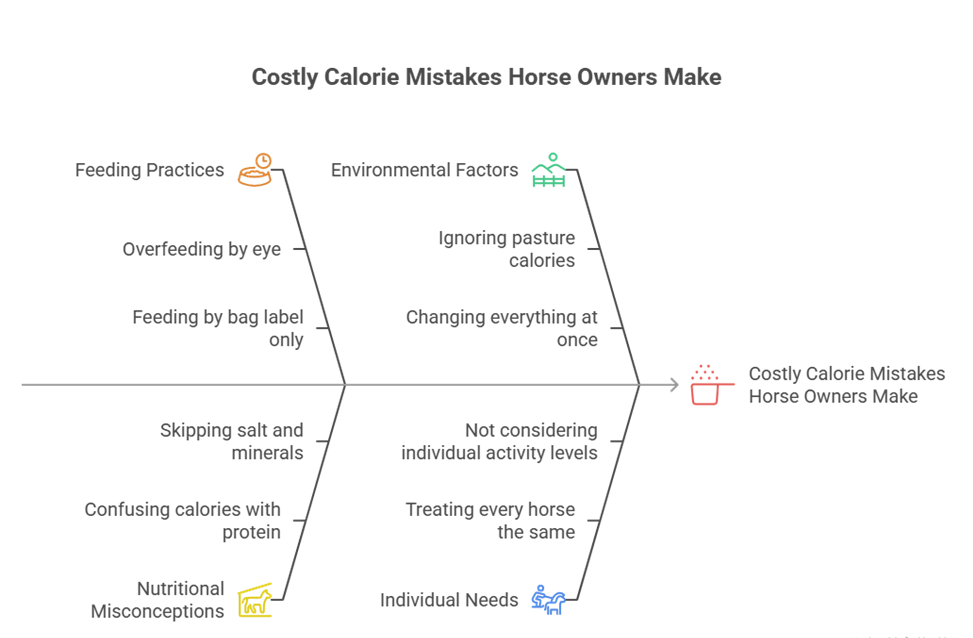
Even careful owners fall into patterns that quietly damage their horses. Seven patterns are worth watching for.
Overfeeding by eye. A full scoop of pelleted feed weighs anywhere from 1.2 to 2.8 pounds depending on density. Weighing feed once with a kitchen scale is eye opening for almost every owner. Consequence: silent weight gain that becomes visible only at the vet’s yearly check, by which time laminitis risk is elevated.
Confusing calories with protein. Protein does not fuel work; digestible energy does. A high protein feed can still be low calorie, driving kidney stress and dull performance. Consequence: expensive feed that does not move body condition.
Ignoring pasture calories. Lush spring grass can supply 30 Mcal DE per day in full turnout, more than a bucket of grain. Consequence: spring laminitis in horses with undetected insulin resistance.
Feeding to the bag label. Bag rates assume an average horse. Yours is not average. Consequence: overfeeding easy keepers and underfeeding hard keepers.
Changing everything at once. Switching hay, grain, and supplement in the same week guarantees a gut upset you cannot diagnose. Consequence: colic or diarrhea with no clear cause.
Skipping salt and mineral. A horse short on salt eats less and performs worse no matter how many calories are offered. Consequence: poor performance, dehydration, and impaction risk masquerading as calorie problems.
Treating every horse as the average horse. A barn of ten horses can have ten different metabolic profiles, yet owners often standardize on one feed. Consequence: slow, invisible drift in body condition across the her
Seasonal and Life Stage Calorie Planning
Calorie needs are not static across the year or the lifetime. Smart owners plan calorie adjustments into their annual calendar rather than reacting after the fact.
In spring, pasture fructan levels rise sharply. Insulin sensitive horses need restricted grazing via muzzles or strip grazing. Reduce concentrates as pasture calories climb.
In summer, heat and humidity increase electrolyte losses. Add daily salt at 1 to 2 ounces, and consider an electrolyte supplement during heavy training weeks. Calorie demand may actually rise because the horse works harder to thermoregulate.
In autumn, forage quality often drops as late cut hay comes in. Test hay before committing to a winter ration. Consider adding fat to sustain condition as pasture disappears.
In winter, maintenance energy needs can increase by 15 to 25 percent during cold snaps. Feed hay rather than grain; fiber fermentation generates internal heat. Provide unfrozen water and monitor drinking; a 10 percent drop in water raises impaction colic risk sharply.
Life stage planning matters too. Foals double in weight by weaning and triple by yearling. Broodmare calorie needs climb in the last trimester and through lactation. Performance horses need seasonal peaks and rest cycles. Seniors need soft, calorie dense, chewable feeds that preserve weight through declining digestion.
Use a simple seasonal calendar to automate the shifts. Mark spring grass reintroduction in April, the summer electrolyte push in late May, the autumn hay transition in September, and the winter calorie boost in November. Horses that experience predictable seasonal patterns adapt faster and show fewer colic and laminitis events over time. Climate zones reshape the seasonal plan as well. Coastal areas with mild winters may skip the cold weather calorie boost entirely. High altitude ranches often need year round fat supplementation. Desert environments demand double the typical water and electrolyte planning.
Building Your Daily Feeding Routine
A calorie plan on paper is only as good as the routine that delivers it. Horses thrive when meals arrive at predictable times, in predictable amounts, with predictable ingredients.
Build your routine around three anchor points. First, split forage into at least three portions spread across the day. Morning, midday, and evening feedings mirror natural grazing patterns and keep stomach acid buffered. Second, feed hay before grain. Even 20 minutes of forage before concentrates slows starch absorption. Third, never leave the horse without forage for more than 6 hours; use slow feed hay nets if you need to stretch a ration.
Water management belongs inside the routine too. Check buckets twice daily and refresh any water that has collected hay, manure, or algae. Horses drink more when water is fresh, clean, and at moderate temperature. Track intake by marking the water level at morning chores and checking again in the evening.
Keep a feeding diary. Record the date, hay flake count, concentrate amount, supplement dose, any leftover feed, and notes on appetite or behavior. A two week diary reveals patterns the eye misses.
Finally, train everyone who touches your horse’s feed. Post a written feeding chart in the feed room with exact amounts, brands, and timing. One inconsistent handler can undo a week of careful ration building. Build a backup feeding plan for vacations, holidays, and emergencies so the routine survives even when you cannot be at the barn. Store a printed version of the feeding chart in the tack room and a digital copy on your phone, and update both after every ration change so there is never a lag between the new plan and the written reference everyone uses.
When to Consult an Equine Nutritionist
There is no shame in calling a professional, and for certain situations it is the fastest route to the right answer.
Call a qualified equine nutritionist if:
- The horse has a diagnosed metabolic condition (Cushing’s disease, equine metabolic syndrome, insulin resistance)
- The horse is under or overweight despite your best adjustments
- The horse is pregnant, lactating, or growing and precise requirements matter
- The horse competes at a level where ration precision affects performance and recovery
- You have switched forage sources and cannot get a current analysis
- You are building a ration from scratch after acquiring a new horse
- The horse has recovered from colic, laminitis, or surgery and needs a customized reintroduction plan
The right professional holds credentials such as a PhD in equine nutrition, membership in the Equine Science Society, or certification through the American College of Veterinary Nutrition. Expect to pay 150 to 400 USD for a full ration analysis, which typically includes a forage test, bloodwork review, body condition assessment, and written plan. Follow up consultations usually run 50 to 150 USD each.
A legitimate consultation process includes an intake form, a recent forage test, vet records, current ration details, and clear photos. The nutritionist builds a custom written plan with specific brands, amounts, and feeding times, and typically offers a follow up at 30 and 60 days.
Red flags: anyone who sells only one brand of supplements, anyone who promises weight gain in under two weeks, anyone who dismisses forage testing, and anyone who does not ask for vet records. Quality nutritionists coordinate with your vet and farrier as a team. The rhythm of a good consultation looks like this: a data collection visit in week one with weights, scores, photos, hay samples, and vet record review; a written plan delivered a week later with specific feeds, amounts, times, and a transition schedule; a check in at 30 days with fresh photos and re scoring; fine tuning at 60 days; and sustainable maintenance at 90 days. Expect steady measurable progress rather than dramatic swings.
Frequently Asked Questions about Horse Calories
How Many Calories Does My Horse Need Daily
A healthy adult 500 kilogram horse in light work needs roughly 20 to 25 Mcal of digestible energy per day. Adjust up or down based on workload, metabolism, and body condition score. Always confirm with a ration review every few weeks.
Can Too Many Calories Harm My Horse
Yes. Excess calories cause weight gain, insulin resistance, laminitis, and reduced longevity. Obese horses face higher risks of metabolic syndrome and joint disease. Calorie excess is now the most common nutritional problem in leisure horses.
How Do I Know If My Horse Is Underfed
An underfed horse shows visible ribs, a hollow flank, prominent spine, dull coat, low energy, and poor muscle tone. A body condition score of 3 or lower is a clear warning. Rule out parasites and dental issues before adding feed.
How Often Should I Adjust My Horse’s Diet
Review the ration every 14 to 21 days when workload, weather, or health changes, and quarterly at minimum. Make small gradual changes and track body condition with every shift. Sudden adjustments invite colic and stress.
What Is the Best Calorie Source for Performance Horses
Fat and high quality forage form the cleanest foundation, paired with controlled starch concentrates as needed. Fat offers 2.25 times the energy of carbohydrates without behavioral spikes. Stabilized rice bran, flaxseed, and cold pressed oils are proven additions.
Should I Feed More Calories in Winter
Usually yes, especially for horses without shelter. Cold weather can raise maintenance needs by up to 20 percent. Extra hay beats extra grain for winter warmth because fiber fermentation generates internal heat.
Is It Safe to Use Vegetable Oil to Add Calories
Yes, when introduced gradually. Start with one quarter cup per day and build to one or two cups over three to four weeks. Choose cold pressed vegetable, flaxseed, or rice bran oil. Keep oil stored cool and sealed to prevent rancidity.
How Do I Calculate Calories in Pasture Grass
Pasture calories depend on species, season, and stocking density. A mature horse on lush spring pasture can consume 15 to 30 Mcal DE per day from grazing alone. A forage specialist or extension agent can test your specific pasture.
Do Senior Horses Really Need Different Calories
Yes. Horses over 18 often lose 10 to 20 percent digestive efficiency as gut function slows and teeth wear unevenly. Soaked senior feeds, beet pulp, and higher fat additions help maintain condition. Monitor weight monthly; seniors lose condition fast once it starts slipping.
Can My Horse Live on Hay Alone
Many can. Adult horses at maintenance or in light work usually do well on quality forage plus a ration balancer and salt. Grain is only necessary when forage cannot meet the energy demand. Always add a vitamin and mineral source when forage is the only calorie base.
Final Thoughts
Choosing the right calories for your horse is not a one time decision. It is a habit you build: weighing feed, scoring body condition, reviewing performance, and adjusting the ration in small, deliberate steps over years.
Start this week. Run this four step checklist:
- Weigh one scoop of your current feed to learn its true pound count.
- Score your horse’s body condition using the Henneke scale.
- Calculate maintenance energy using the NRC equation and add your workload percentage.
- Compare the calculated target to what you are actually feeding.
If the picture you see does not match the picture you want, adjust the ration slowly over the next two weeks and measure again. Keep a simple feeding log. Record the date, feed, amount, body condition, and any notable changes in work or behavior. Over six months that log becomes the most valuable nutrition document your horse has.
The horse in your barn cannot tell you in words what its metabolism needs. The calorie plan you build, tested against body condition and performance, is how you listen. Feed the horse in front of you, not the average horse on a bag label, and you will build an athlete that thrives season after season.
One last reminder. Nutrition is not a solo discipline. Pair your calorie planning with regular dental work, fecal egg count guided parasite control, a consistent farrier schedule, and an honest conversation with your vet twice a year. When everything is in sync, the ration you design becomes visible in every stride and every clean bill of health. Commit to the routine. Trust the numbers. Watch the horse. Over the years the payoff compounds: a horse that stays sound longer, performs at a higher level, and shares more miles under saddle with you than either of you expected when the first scoop went into the bucket.