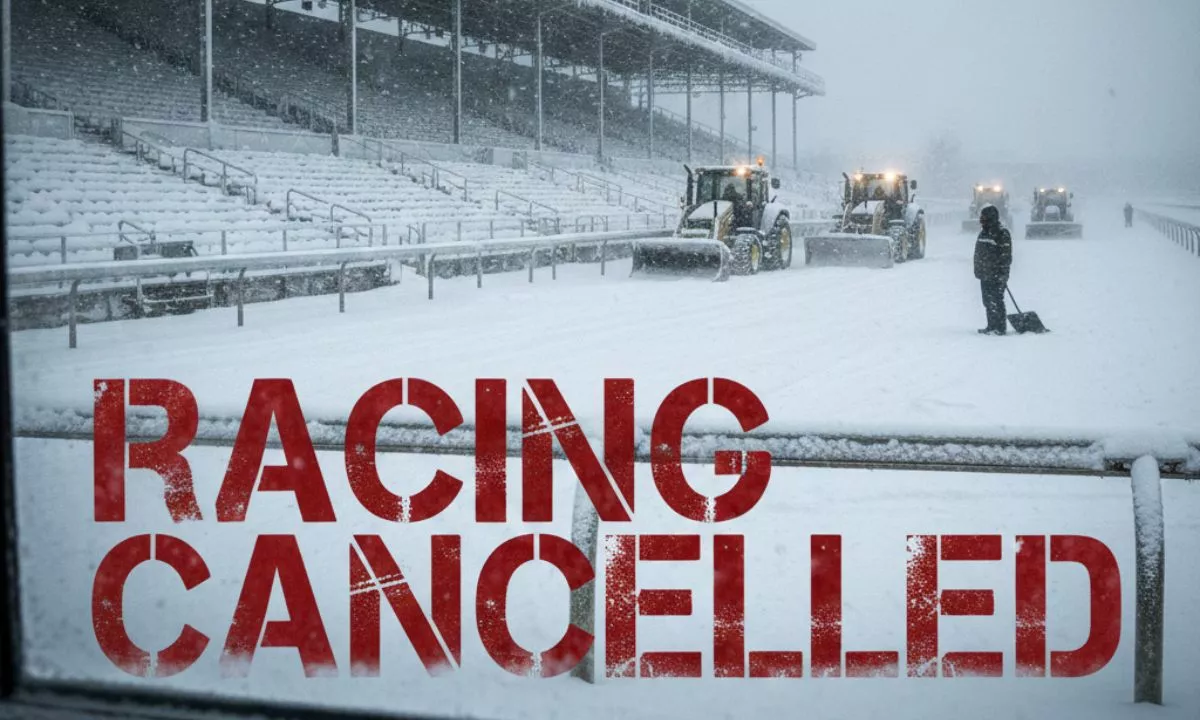
The mid-winter racing calendar has slammed into a wall of ice and arctic air this week, as a sprawling meteorological system threatens to paralyze logistics and hazardous conditions have triggered a wave of winter storm horse racing cancellations across the United States. From the synthetic oval of Northern Kentucky to the historic grounds of Aqueduct Racetrack in New York, racing secretaries are scrambling to redraft condition books while horsemen hunker down against plunging temperatures.
With the National Weather Service issuing warnings for heavy snow, flash freezing, and life-threatening wind chills, the industry is prioritizing safety over handle. As of Thursday afternoon, marquee tracks including Turfway Park and Aqueduct have already scrapped cards, with officials at Oaklawn Park, Laurel Park, and Charles Town closely monitoring a system that threatens to disrupt not just the weekend slate, but training schedules for major spring campaigns.
The Northern Kentucky Freeze: Turfway Goes Dark
The most immediate impact of the winter storm horse racing cancellations has been felt in Florence, Kentucky. Turfway Park, known for its resilient Tapeta surface which typically allows racing to continue through rain and moderate snow, has been forced to concede to the temperature.
Turfway officials announced early Thursday that live racing for Friday, Jan. 23, and Saturday, Jan. 24, has been cancelled. While the synthetic surface is designed to remain consistent in adverse weather, the deciding factor was the wind chill. Forecasts predict ambient temperatures dropping to single digits, with wind chills plummeting to minus 10 degrees Fahrenheit or lower during post times.
“At a certain point, the surface becomes secondary to human and equine exposure,” said a racing office representative. “We can keep the track safe for footing, but we cannot ask jockeys, outriders, and gate crew to operate in minus-15 degree wind chill, nor is it responsible to expose the horses to that air for extended periods.”
The cancellation is a significant blow to the local colony, wiping out two lucrative weekend cards. Saturday’s feature, the $125,000 Wishing Well Stakes, was set to draw a competitive field of older fillies and mares. The racing office has indicated that the Wishing Well will likely be brought back as an extra race on a subsequent card, potentially next weekend, though entries will need to be redrawn.
This disruption places trainers in a difficult position. Horses keyed up for a peak performance this Saturday must now be kept on edge for another week or forced to breeze in sub-optimal conditions to maintain fitness. For barns fighting for stall space and purse money in the competitive winter meet, the loss of two racing days represents a tangible economic hit.
Aqueduct Pivots: The Sunday Shift
In Ozone Park, New York, the New York Racing Association (NYRA) has taken a proactive approach to the winter storm horse racing cancellations. Rather than waiting for the first flakes to fall, NYRA announced on Thursday that the program scheduled for Sunday, Jan. 25, at Aqueduct Racetrack has been postponed.
In a strategic move to preserve the racing opportunities, NYRA has shifted the Sunday card in its entirety to Wednesday, Jan. 28. This decision allows the track to bypass the brunt of the storm, which is expected to dump 6 to 10 inches of snow on the New York metropolitan area throughout Sunday, followed by a rapid freeze.
“The safety of our equine athletes and the jockeys is paramount,” NYRA said in a press release. “By moving the Sunday card to Wednesday, we ensure a safe surface and safe travel conditions for our horsemen and fans.”
The “Big A,” as Aqueduct is affectionately known, is the backbone of winter racing in the Northeast. While the inner track of years past is gone, the current limestone base and winterized maintenance fleet are capable of handling standard winter weather. However, the timing of this storm—hitting exactly during race hours—made proceeding impossible.
The shift to Wednesday creates a “super-week” of sorts for handicappers, but it disrupts the rhythm of the jockey colony. Many of New York’s riders were scheduled to travel or take days off early next week; now, they will be back in the irons midweek to make up for the lost weekend handle.
The Domino Effect: Will Rogers and Beyond
The storm system is cutting a diagonal path across the country, and the winter storm horse racing cancellations are following the same trajectory.
Will Rogers Downs in Claremore, Oklahoma, has cancelled its cards for Jan. 26-27. The system moving through the Plains is expected to bring a mix of freezing rain and sleet, the most dangerous precipitation type for a dirt track. Unlike snow, which can be harrowed or floated off if caught early, ice binds the cushion, creating an uneven and treacherous surface that can cause catastrophic injuries.
Meanwhile, tracks in the Mid-Atlantic are on high alert. Laurel Park in Maryland and Charles Town in West Virginia are currently holding entries for the weekend, but insiders suggest that decisions will be made by Friday morning. The “wintry mix” line is hovering dangerously close to the Mason-Dixon line. If the precipitation stays as rain, racing may proceed on sloppy tracks; if it turns to ice, cancellations are inevitable.
Oaklawn Park in Hot Springs, Arkansas, is also monitoring the system. While currently just outside the worst of the projected impact zone, any southward shift in the jet stream could bring freezing rain into the area, threatening their lucrative weekend cards which often feature key prep races for the Arkansas Derby.
The Science of the Scratch: Why Tracks Cancel
For the casual fan, a little snow might seem like a manageable hurdle. However, the decision to trigger winter storm horse racing cancellations involves a complex calculus of biomechanics, surface engineering, and logistics.
1. The Surface Mechanics
Dirt tracks are living ecosystems. To keep them safe in winter, maintenance crews “seal” the track—packing it down so water runs off the top rather than soaking into the cushion. However, when temperatures drop below freezing, the moisture in the dirt can turn into frozen clods. If a horse steps on a frozen clod of dirt at 35 mph, it is akin to stepping on a rock. It causes stone bruises, quarter cracks, or worse, soft tissue injuries due to uneven footing.
Synthetic tracks like Turfway’s Tapeta are immune to freezing clods because they use wax-coated sand, rubber, and fiber rather than dirt and water. However, even synthetic tracks have limits. If heavy snow accumulates faster than the tractors can clear it, it packs into the wax, altering the consistency and making the surface slippery.
2. The Respiratory Factor
Physiology plays a massive role in winter storm horse racing cancellations. Thoroughbreds are high-performance athletes with massive lung capacities. During a race, a horse inhales roughly 1,500 liters of air per minute. When the air temperature is below 10 or 15 degrees, that freezing air rushes deep into the lungs before it can be warmed by the upper respiratory tract.
This can cause “cold air-induced pulmonary hemorrhage” or damage the lining of the lungs. Furthermore, the sheer shock of freezing air can inhibit performance. Veterinary guidelines often suggest caution when wind chills dip below zero, as the risk of muscle tears increases when muscles cool down too rapidly post-race.
3. The Human Element
Jockeys wear thin silks and possess very little body fat. Perched atop a horse moving at 40 mph creates a significant wind chill effect on top of the ambient weather. At 20 degrees Fahrenheit, a jockey moving at race speed feels a wind chill well below zero. Frostbite on exposed skin (face, hands) can occur in minutes. Furthermore, stiff, frozen fingers cannot effectively grip reins or handle a whip, creating a safety hazard for everyone in the race.
Economic Impact on the Industry
The wave of winter storm horse racing cancellations is not just a logistical headache; it is a financial blow. The winter racing economy relies on the “simulcast signal.” When a track like Aqueduct or Turfway cancels, it doesn’t just lose the money bet on-track (which is minimal in winter); it loses the millions of dollars wagered from California, Florida, and online betting platforms.
For a mid-level track, a lost Saturday card can represent a loss of $2 million to $4 million in handle. For the horsemen, the impact is even more personal.
- Jockeys: No race means no mount fees (typically $50-$100 per mount) and no chance at earning a percentage of the purse.
- Grooms and Hotwalkers: These workers still have to care for the horses—feeding, mucking stalls, walking them in the shedrow—regardless of the weather. The work becomes harder in the cold, but the potential for bonus money from winning purses vanishes.
- Owners: Day rates (the cost to keep a horse in training) average $80 to $120 per day. A cancelled race means paying for another week or two of training without an opportunity to earn that money back.
“It trickles down,” says a trainer based at Turfway Park. “We spend all month getting a horse ready for this specific Saturday. Now we have to wait. That’s another week of feed, another week of vet bills, and we miss the purse. If you’re a small barn, two weeks of cancellations can put you in the red for the month.”
The Silver Lining: Rescheduling and Recovery
Despite the gloom of the forecast, the industry is resilient. Racing secretaries are already working the phones to ensure that the winter storm horse racing cancellations don’t result in lost opportunities, but merely delayed ones.
The stakes races lost this weekend will be rescheduled. The “extras” in the condition book will fill up rapidly as trainers look to run horses that were scratched. Next week’s cards at Aqueduct and Turfway are expected to be “overfilled,” with large field sizes that are attractive to bettors.
Furthermore, the pause provides a brief respite for the track maintenance crews. Once the storm passes, they will have a few days to rework the cushions, grade the surfaces, and ensure that when racing returns, the tracks are in peak condition.
Looking Ahead: The Forecast
As of the Thursday update, the storm track seems to be locking in. The worst of the impact for the Midwest will occur Friday night into Saturday morning, while the Northeast will bear the brunt Saturday night into Sunday.
Handicappers looking for action this weekend will likely have to turn their eyes South and West. Gulfstream Park in Florida, Tampa Bay Downs, and Santa Anita Park in California are unaffected by the arctic blast. In fact, these tracks likely stand to benefit significantly in terms of simulcast handle, as they will be the “only game in town” for horseplayers stranded by the blizzard.
However, for the faithful followers of the winter dirt and synthetic circuit, patience is the only option. The winter storm horse racing cancellations are a reminder that in this sport, Mother Nature always handicaps the field last.
Horseplayers are advised to check Equibase or specific track websites for the most up-to-date information on scratches and rescheduling before heading to the simulcast centers this weekend.