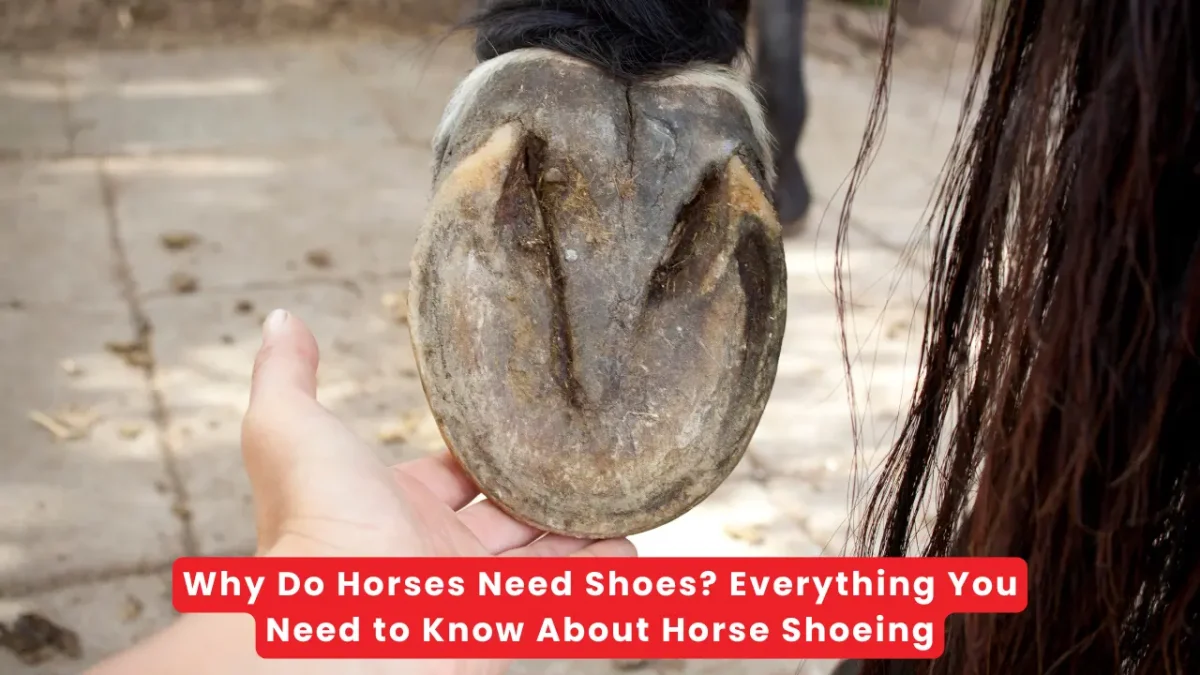
Why do horses need shoes is one of the most important questions in equine care, because domestic life exposes horses to surfaces, workloads, and conditions that their hooves cannot naturally withstand without professional support. If you have ever wondered about this, you are not alone among new horse owners, curious riders, and anyone stepping into the world of equine care. After all, wild horses roam across thousands of miles each year without a farrier in sight. So why do domestic horses need regular shoeing appointments?
The answer lies in how we use horses today and the environments we ask them to work in. Domestic horses face challenges that their wild counterparts simply do not encounter. Hard surfaces, heavy workloads, and demanding athletic performance place enormous pressure on a horse’s hooves. Without proper hoof care and adequate protection, that pressure leads to discomfort, injury, and long term health complications.
Understanding why horses wear shoes is not simply trivia for curious horse lovers. It is essential knowledge for any responsible owner. The choices you make around hoof care directly affect your horse’s comfort, soundness, and performance. Whether you are a new owner or a seasoned rider, this guide covers everything you need to know about horse shoeing.
| KEY TAKEAWAYS |
| Domestic horses often need shoes to protect their hooves from wear on hard or uneven terrain.Not all horses require shoes; the decision depends on workload, hoof quality, and living environment.A qualified farrier should assess your horse’s hooves every four to six weeks, whether shod or barefoot.Horseshoes come in many types, including steel, aluminum, and therapeutic designs, each suited to specific needs.Regular hoof care is fundamental to equine health, and neglect can lead to serious lameness and long term injury. |
Why Do Horses Need Shoes? A Complete Beginner’s Guide
Horses need shoes primarily because domestication has fundamentally changed the conditions they live and work in. In the wild, horses travel up to 30 miles each day across varied terrain, and this constant natural movement gradually toughens their hooves to a resilient state. Domestic horses, by contrast, spend much of their time in stalls or paddocks and are ridden on surfaces their hooves were never naturally designed to endure on a daily basis.
Here is the key thing: hoof protection is not just about the outer wall of the hoof. It is about protecting the entire horse. The hoof connects to tendons, ligaments, and bones that run up through the lower leg. When the hoof wears unevenly or the sole lacks adequate protection, stress and imbalance travel throughout the entire musculoskeletal system with every step the horse takes.
Horseshoeing has a history that stretches back more than two thousand years. Evidence suggests that the ancient Celts and Romans used early forms of hoof protection, while the classic nailed iron horseshoe became widespread in Europe around the ninth century. According to the American Farrier’s Association, modern horseshoeing techniques have evolved enormously over the centuries, but the core purpose remains unchanged: protecting the hoof and supporting the horse’s overall soundness throughout its working life.
Why do horses need shoes in the context of modern equestrian sport? The answer becomes especially clear when you consider different disciplines. Show jumping demands secure traction on takeoff and landing. Long distance trail riding requires protection against sharp rocks and roots. Dressage horses work on hard arena floors repeatedly, placing concentrated stress on their joints and hooves. A horse recovering from a soft tissue injury may also need specialized therapeutic shoes to support the healing process.
Individual variation plays a major role that many new owners overlook. Not every horse is the same. Hoof hardness, sole thickness, and overall hoof quality vary enormously between individual animals. These differences directly influence how much protection a horse needs. What keeps one horse perfectly sound may be entirely unnecessary for another horse in very similar working circumstances.
For those just starting out in horse ownership, the most essential takeaway is this: hoof care is not optional. Every horse, whether shod or barefoot, requires regular attention from a qualified farrier. The National Farriers Association recommends that horses receive hoof trims or shoe changes at least every six weeks, and more frequently for horses in heavy work or with existing hoof health challenges.
The Purpose of Horseshoes and Why They Matter
Horseshoes serve several interconnected purposes that go well beyond simple tradition or aesthetics. At their most basic level, they protect the hoof wall from excessive wear on abrasive or hard surfaces. The hoof wall is the hard outer layer of the hoof, and it bears the brunt of every step a working horse takes. But a well fitted horseshoe also provides traction, improves balance, and in many cases offers essential therapeutic support.
A horseshoe is a protective device fitted to the underside of a horse’s hoof to prevent excessive wear, improve traction, and correct biomechanical imbalance, because domestic horses are routinely exposed to surfaces and workloads that exceed the natural regenerative capacity of an unprotected hoof. This definition captures why so many working horses benefit from consistent shoeing throughout their active careers.
Horseshoes are traditionally made of steel or aluminum and are nailed or glued to the underside of the hoof. They distribute the horse’s weight more evenly across the hoof structure and act as a protective layer between the sensitive internal tissues of the foot and the hard ground beneath. When sized and fitted correctly, the shoe becomes a functional extension of the hoof itself.
Think of it this way: horseshoes are to a horse what sturdy work boots are to a construction worker. They are tools designed to match a specific job. A horse ridden regularly on asphalt or gravel roads needs protection that a horse living on soft, varied pasture land may not require at any point in its routine.
The importance of proper shoeing has been well documented in equine science. Research published in the Equine Veterinary Journal has demonstrated that incorrectly fitted or poorly maintained horseshoes can actually increase the risk of injury by altering the biomechanical forces acting on the horse’s joints and tendons. This reinforces the essential role of a skilled and experienced farrier. A poorly fitted shoe is not a neutral decision. In many circumstances, it is worse than no shoe at all.
But here is where many horse owners go wrong: they focus entirely on the question of whether to shoe their horse, rather than on the quality and fit of the shoe once that decision is made. Shoeing a horse poorly, or using a shoe that does not match the horse’s individual conformation and workload, creates problems rather than solving them.
How Horse Hooves Work and Why Protection Is Needed
To truly understand why horses need shoes, you need to understand how hooves work at a structural level. The horse’s hoof is not simply a hard outer shell. It is a complex, living structure made up of several interconnected components that work together to absorb impact, support body weight, and propel the horse forward with every stride.
The main structural components of a horse’s hoof include the following:
- The hoof wall: the hard, protective outer layer made of keratin, the same structural protein found in human fingernails and hair.
- The sole: the concave underside of the hoof that protects internal structures from direct ground contact.
- The frog: a triangular, rubbery structure at the back of the underside that acts as a natural shock absorber and provides grip on varied terrain.
- The white line: the junction between the outer hoof wall and the inner sensitive tissues, which is vulnerable to infection if damaged.
- The coffin bone: the primary weight bearing bone inside the hoof capsule, also known as the pedal bone, which carries the horse’s mass.
- The laminar tissue: sensitive and insensitive layers that bond the hoof wall to the coffin bone, giving the hoof its structural integrity and stability.
- The digital cushion: a fibrous, fatty pad at the back of the hoof that absorbs significant impact during movement and active work.

The frog deserves special attention. Unlike the rigid hoof wall, the frog is pliable and responsive. With each step, it contacts the ground and deforms slightly, acting like a pump that helps circulate blood back up through the lower limb. This is why hoof health is so directly connected to circulation in the horse’s legs. A horse whose frog never contacts the ground can develop circulation problems over time.
But here is where most horse owners go wrong: they think of the hoof as a static structure, when in reality it continuously adapts to the pressures and demands placed on it. A hoof regularly exposed to hard, dry surfaces without adequate protection develops micro injuries over time. Small cracks form in the wall, the sole thins, and the internal structures begin to experience increasing stress with every step.
According to Dr. Stephen O’Grady, a leading equine podiatrist and founder of Virginia Farriery, maintaining proper hoof balance is the single most important factor in equine soundness. Hoof imbalance places uneven stress on the coffin joint, tendons, and ligaments, creating conditions that accelerate the development of serious problems such as laminitis, navicular syndrome, and chronic soft tissue injuries throughout the lower limb.
The bottom line is this: hooves are not built for the modern demands of domestic horse life. They need consistent support through regular trimming, careful management of living conditions, and where appropriate, protective shoeing tailored to the individual horse and its specific work environment and daily routine.
Main Reasons Why Horses Need Shoes
Understanding the general importance of hoof care is one thing. Understanding the specific, practical reasons a farrier might recommend shoes for a particular horse is another. There are three core reasons that account for the vast majority of shoeing decisions made by equine care professionals worldwide.
Protection from Wear and Tear
The most fundamental reason horses need shoes is to protect the hoof from excessive wear. When a horse’s workload or living environment places more physical demand on the hoof than it can naturally maintain, shoes become a necessary intervention. Without this protection, the hoof wears faster than it can regrow, leading to discomfort, bruising, and eventually a horse that cannot work safely.
Consider a horse used for trail riding on rocky mountain terrain. Every step on sharp or abrasive ground removes a small fraction of the hoof wall. Without protection, the hoof becomes progressively shorter and thinner until the sole is exposed and the horse can no longer work comfortably. The shoe acts as a physical barrier, preserving hoof structure and allowing the hoof to grow and function properly over the long term.
This concern applies equally to horses kept on concrete surfaces in stable yards. Even horses not ridden frequently but spending many hours standing on hard concrete may develop hoof thinning over time that warrants protective shoeing as a practical preventive measure before damage becomes irreversible.
Improved Traction and Grip
Traction is another critical reason for shoeing, particularly in athletic and working horses. On wet grass, mud, or loose dirt, an unshod hoof can slip in ways that place both horse and rider at risk. Horseshoes can be fitted with traction devices such as calks, also called studs, or borium applied to the shoe that dramatically improves grip on challenging terrain.
The bottom line is this: for competition horses, traction is not merely a comfort concern. It is a fundamental safety issue. Show jumping horses need to land and push off with complete confidence. Eventers need to grip uneven and variable ground throughout a course. Even a pleasure horse on a wet winter field benefits significantly from predictable, stable footing beneath every step.
Modern farriery offers a wide range of traction solutions tailored to specific disciplines and seasonal conditions. Working closely with your farrier to choose the right configuration for your horse’s job is a practical investment in both performance and the long term safety of horse and rider alike.
Support for Weak or Damaged Hooves
Not all horses are born with perfect hoof conformation. Some horses have naturally thin or flat soles that make them prone to bruising on anything but the softest ground. Others develop conditions such as white line disease, a bacterial and fungal infection of the white line junction, or laminitis, a painful inflammatory condition of the sensitive laminar tissue inside the hoof capsule that requires prompt and careful long term management.
In these cases, horseshoes serve a therapeutic rather than simply protective purpose. Specialized designs such as heart bar shoes, egg bar shoes, and wedge shoes can each offload pressure from damaged areas, support the coffin bone in its correct anatomical position, and allow injured tissue the time and conditions needed to heal properly and completely.
Research published in the Journal of Equine Veterinary Science found that corrective shoeing significantly improved outcomes in horses recovering from laminitis when compared to standard management alone. This reinforces the value of treating the farrier and veterinarian as a collaborative team working toward the best possible outcome for the horse’s long term soundness.
Do All Horses Need Shoes?
This is one of the most debated questions in the equine community, and the honest answer is no. Not all horses need shoes. Whether a horse should be shod depends on several interrelated factors, including the individual horse’s hoof quality, current workload, terrain, living conditions, age, and overall health status at any given point in its life.
Many horses live happy, sound, and active lives entirely barefoot. The barefoot movement in modern equine care has grown substantially over the past two decades. Advocates point to benefits such as improved hoof mechanism, better circulation through full frog contact with the ground, and reduced long term reliance on metal shoes and the regular farrier visits that accompany a shod management program throughout the year.
Here is the key thing: going barefoot is not simply the absence of shoes. A genuine barefoot approach requires careful and consistent hoof management. Horses transitioning from shoes to barefoot typically go through an adjustment period during which their hooves toughen and adapt to direct ground contact. This transition can take several months and requires close monitoring by a knowledgeable farrier throughout the entire process.
Horses that tend to be well suited to barefoot management typically have naturally hard and dense hoof walls, live on varied terrain that provides natural stimulation and moderate wear, are not in heavy or competitive athletic work, and receive consistent professional trimming every four to six weeks without fail. Meeting these conditions is essential to a successful barefoot program.
On the other hand, horses are more likely to need shoes when they are used for regular work on hard or abrasive surfaces, have thin or flat soles that bruise easily, are recovering from a hoof related injury, compete in disciplines that require specific traction configurations, or live in environments where natural hoof wear is insufficient to maintain a healthy hoof length and shape over time.
Barefoot vs Shoed Horses: Key Differences
The discussion between barefoot and shod horse management has become one of the defining conversations in contemporary equine care. Both approaches have genuine merit, and neither is universally right or wrong for all horses in all situations. Understanding the key differences empowers you to make a well informed and individualized decision for your own horse based on their specific needs and circumstances.
| Factor | Barefoot Horses | Shoed Horses |
| Hoof mechanism | Natural expansion each step | Slightly restricted by shoe |
| Circulation | Enhanced through frog contact | Can reduce if frog is lifted |
| Traction | Natural; limited on slippery surfaces | Customizable with studs or borium |
| Wear protection | Relies on hoof toughening over time | Provided directly by the shoe |
| Long term cost | Lower farrier costs overall | Higher due to materials and labor |
| Maintenance cycle | Trim every 4 to 6 weeks | Reset or replace every 4 to 6 weeks |
| Best terrain | Varied, natural footing | Hard, abrasive, or slippery surfaces |
| Athletic demands | Light to moderate work | Heavy or competitive disciplines |
Here is the key thing: when reading this comparison, remember that individual horse variation, management quality, and environmental conditions all influence outcomes just as much as the choice of shoeing itself. A well managed barefoot horse on appropriate terrain will consistently do better than a poorly maintained shod horse worked on inappropriate surfaces with irregular farrier care across the year.
Some owners successfully use a hybrid approach, keeping their horses barefoot during winter when work is lighter and the ground naturally softer, then shoeing them at the start of a competition season when workloads increase and surface demands change significantly. This flexible approach allows owners to respond to their horse’s actual needs rather than adhering rigidly to either philosophy throughout the year.
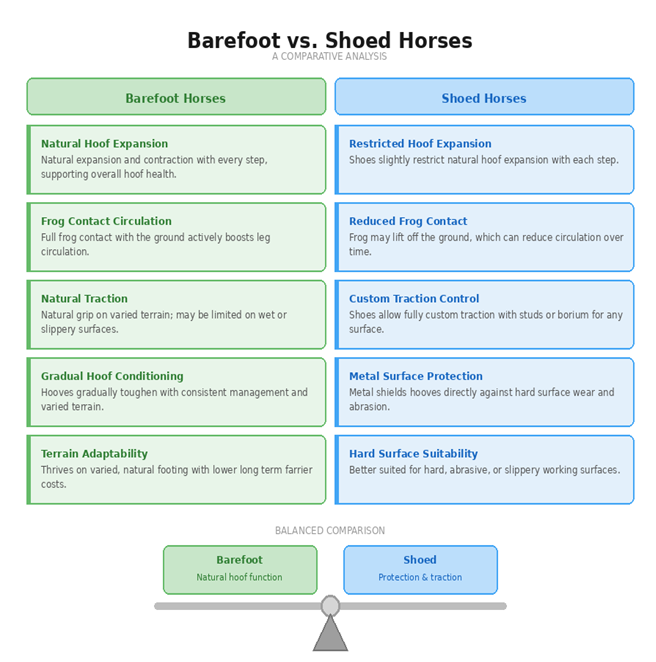
The bottom line is this: what matters most is consistency and quality of care rather than the specific method chosen. A horse that is regularly trimmed, thoughtfully managed, and monitored closely will almost always do better than a horse receiving infrequent or low quality hoof care. The shoe is a tool. The attention you give your horse’s hooves makes the true difference in their long term soundness.
Types of Horseshoes and Their Uses
One of the most common misunderstandings about types of horseshoes is that all shoes are essentially the same: a piece of curved metal nailed to a hoof. In reality, there is a wide and sophisticated variety of shoe designs and materials, each engineered for a specific purpose and a specific set of conditions. Understanding the options helps you have a more productive conversation with your farrier.
Steel shoes are the most traditional and most widely used type. They are durable, cost effective, and appropriate for most working horses across a wide range of disciplines and work levels. Steel is heavier than aluminum but holds its shape reliably under hard, sustained use, making it a practical choice for everyday riding horses, trail horses, and horses in general work across varied terrain.
Aluminum shoes are significantly lighter than steel, which makes them popular in racing and high level competition. A lighter shoe reduces the energy the horse expends with each stride, which over the course of a long race or cross country course can improve speed and reduce fatigue meaningfully. Aluminum does wear faster than steel and may need replacing more frequently, which is a practical consideration for owners managing costs.
Rubber and plastic shoes are increasingly used for horses with specific sensitivity, including those recovering from injury or horses working on hard flooring such as indoor arenas or paved roads. These materials offer a degree of cushioning that rigid metal simply cannot provide, making them valuable in therapeutic and transitional management programs where the horse’s comfort during recovery is a primary priority.
Therapeutic and corrective shoes represent a broad and important category. Heart bar shoes incorporate an additional bar across the toe to support the frog and relieve pressure on the coffin bone, and they are frequently used in laminitis management. Egg bar shoes extend behind the heels to provide extra support for horses with navicular syndrome or chronically weak heels. Wedge shoes elevate the heel to reduce strain on the deep digital flexor tendon during recovery from soft tissue injuries.
Rim shoes feature a groove around the outer edge that improves grip on grass and soft ground, and they are popular in eventing, show jumping, and polo. Studs or calks can be added to most shoe types and removed as surface conditions require, allowing precise traction management on competition day or across changing seasons throughout the year.
When Should a Horse Be Shoed?
Knowing when to shoe a horse involves understanding both the natural growth cycle of the hoof and the specific circumstances that call for shoes in the first place. In terms of routine timing, most horses that wear shoes need to have them replaced or reset every four to six weeks. This aligns with the natural growth rate of the hoof, which is approximately a quarter of an inch per month.
As the hoof grows, it pushes the shoe progressively further forward, changing the balance of the foot and placing increasing stress on the nails and surrounding structures. Left too long without attention, this imbalance causes the shoe to loosen, twist, or be lost entirely, causing immediate disruption to the horse’s work and comfort.
Here is the key thing: it is not always about whether the shoe looks worn. Even if a shoe appears physically intact and in good condition, the hoof beneath it has grown and changed shape since the shoe was applied. The shoe no longer conforms to the foot the way it did when it was fresh. This mismatch needs to be corrected on schedule, regardless of how the shoe appears from the outside.
Beyond routine maintenance, specific circumstances indicate that a horse may benefit from being shod. These include the beginning of a new season of increased work, a change to harder or more abrasive working surfaces, a new veterinary diagnosis of a hoof or soundness condition, or a return to work after a rest period during which the horse has been maintained barefoot.
Young horses beginning training may need to be shod earlier than anticipated if their hooves show signs of stress under a new and more demanding workload. Older horses may experience age related hoof deterioration requiring more consistent protective shoeing throughout the year. There is no universally correct timeline, and every horse’s needs deserve individual consideration and expert assessment.
Signs Your Horse Needs Shoes
Attentive horse hoof care involves more than scheduling farrier visits. It also means monitoring your horse daily for signs that protective shoeing may have become necessary. Recognizing these indicators early helps you act before minor issues develop into serious problems or cause lasting structural damage to the hoof and the tissues it protects.
- Chipping and cracking of the hoof wall: Small chips that develop into larger cracks indicate that the hoof is wearing faster than it is growing. This is particularly common in horses worked regularly on abrasive or gravelly surfaces without hoof protection.
- Thin or sensitive soles: If your horse flinches, stumbles, or moves cautiously on gravel, stones, or uneven ground, their soles may have worn too thin to provide adequate natural protection for the internal structures below.
- Uneven wear patterns: If one section of the hoof is wearing significantly faster than another, this points to a balance issue that shoeing and corrective trimming by a qualified farrier may be needed to address and resolve.
- Soundness changes: Any new lameness, shortened stride, or reluctance to bear weight on a particular foot warrants prompt attention from both a farrier and a veterinarian without any delay.
- Hoof condition deterioration after going barefoot: If a horse transitioning away from shoes shows persistent discomfort or structural hoof changes that do not resolve with trimming alone, shoes may be the appropriate and necessary response.
The bottom line is this: you know your horse better than anyone else. Trust what you observe. A horse that is uncomfortable in its feet will communicate that discomfort through changes in behavior, alterations in movement, and visible physical changes to the structure and appearance of the hoof itself. Responding promptly to these signals is one of the most important things you can do as a responsible and attentive horse owner.
FAQs About Why Horses Need Shoes
Why do horses need shoes in the first place?
Horses need shoes because domestication exposes them to conditions that exceed their hooves’ natural maintenance capacity. Hard surfaces, demanding athletic work, insufficient natural terrain variation, and specific health conditions can all place more strain on the hoof than it can handle without additional protection. Horseshoes provide that protection and, in many cases, offer essential therapeutic support that keeps horses sound and working comfortably for many years throughout their active careers.
Can horses live without shoes?
Yes, many horses live healthy, active, and comfortable lives without shoes throughout their working careers. The barefoot approach is entirely valid when a horse has strong and healthy hooves, lives and works on suitable terrain, and receives consistent farrier care on a regular schedule. Not every horse is a candidate for barefoot management, but a significant number thrive with it. The key is regular professional care and attentive monitoring rather than simply removing the shoes and hoping for the best.
Do wild horses need shoes?
Wild horses do not need shoes because their lifestyle naturally provides everything necessary for hoof maintenance. They travel continuously over diverse terrain, which wears and toughens the hoof at a rate that matches natural growth. They are also not subject to the concentrated workloads of domestic sport horses or farm horses. However, wild horses that are captured and brought into a domestic environment do eventually need farrier care as their lifestyle and living conditions change significantly.
How often should horseshoes be replaced?
Horseshoes should generally be replaced or reset every four to six weeks, depending on how quickly the individual horse’s hooves grow and how much wear the shoes accumulate during work. Horses in heavier work or on particularly abrasive surfaces may need attention more frequently. You should not let more than eight weeks pass between farrier visits for a shod horse, as hoof balance will have shifted significantly and the risk of losing a shoe or developing imbalance and lameness increases substantially.
Are horseshoes painful for horses?
No. When applied correctly by a skilled farrier, horseshoes are not painful for the horse. The outer hoof wall, where the nails are driven, has no nerve endings, similar in principle to human fingernails. The nails are carefully driven through the insensitive outer wall at a specific angle designed to avoid all sensitive internal tissue completely. A horse showing signs of pain during or after shoeing is likely experiencing an underlying hoof problem that should be evaluated promptly by a veterinarian.
What happens if a horse does not get shoes when it needs them?
If a horse that genuinely needs shoes goes without them, the hoof will gradually wear beyond its natural capacity to repair itself. This leads to thin soles, exposed sensitive structures, repeated bruising, cracking, and eventually lameness that affects the horse’s entire way of going. Over time, untreated hoof deterioration causes damage that extends to tendons, joints, and in severe cases to bones. In the most serious cases, neglected hoof health permanently compromises a horse’s soundness and quality of life and may end their working career prematurely.