
If you have ever stood next to a horse and wondered just how much that magnificent animal actually weighs, you are not alone. Horse weight is one of the most commonly searched questions among new and experienced horse owners alike and for good reason. Knowing exactly how much your horse weighs is not just a matter of curiosity. It is a critical piece of information that affects feeding, medication dosing, health monitoring, and overall care.
So, how much does a horse weigh? The short answer is that most adult horses weigh between 900 and 2,200 pounds (410 to 1,000 kg), depending on breed, age, sex, and body condition. But that range is wide and understanding where your horse falls within it, and why, is what this guide is all about.
Average Horse Weight at a Glance
For readers who need a fast reference, here is a summary of average horse weights by type before we go deeper into the details.
Horse Type Average Weight (lbs) Average Weight (kg) Light Horse (Thoroughbred, Arabian) 900 – 1,200 410 – 545 Stock Horse (Quarter Horse, Paint) 1,000 – 1,300 450 – 590 Warmblood and Sport Horse 1,200 – 1,500 545 – 680 Draft Horse (Clydesdale, Shire) 1,800 – 2,400 815 – 1,090 Pony 400 – 900 180 – 410 Miniature Horse 150 – 350 70 – 160 Newborn Foal 100 – 200 45 – 90
These figures represent healthy adult horses in normal body condition. Individual horses may fall above or below these ranges depending on several factors we will cover throughout this guide.
How Much Does an Average Horse Weigh?
The average horse weighs approximately 1,000 to 1,100 pounds (450 to 500 kg). This figure represents the mid-range of the most common domestic horse breeds primarily light horses and stock horses that make up the majority of the global horse population.
It is important to understand that “average” is relative to the type of horse being discussed. A Thoroughbred racehorse and a Belgian Draft horse are both horses, but they live on opposite ends of the weight spectrum, separated by as much as 1,400 pounds.
Average Horse Weight in Pounds
In the United States and other countries using imperial measurements, horse weight is most commonly expressed in pounds. A healthy, well-conditioned adult light horse typically weighs between 900 and 1,200 lbs. Stock breeds like the Quarter Horse sit at 1,000 to 1,300 lbs, while heavier sport horses and warmbloods range from 1,200 to 1,500 lbs.
Draft horses are in a category entirely their own. Breeds like the Shire and Clydesdale regularly exceed 2,000 lbs, with exceptionally large individuals reaching 2,600 lbs or more. These are the heaviest domesticated horses in existence.
Average Horse Weight in Kilograms
For international horse owners, veterinarians, and researchers working in metric units, the same averages translate as follows. A typical light horse weighs 410 to 545 kg. Stock horses weigh 450 to 590 kg. Warmbloods and sport horses fall in the 545 to 680 kg range. Draft horses range from 815 to 1,090 kg, with the largest individuals exceeding 1,100 kg.
Medication dosing in veterinary practice is almost always calculated in kilograms, which makes knowing your horse’s weight in kg particularly important for health management purposes.
Average Horse Weight by Breed
Breed is the single most reliable predictor of a horse’s weight range. Generations of selective breeding have produced horses that vary dramatically in size, bone density, and muscle mass. Here is a detailed breakdown by breed category.
Light Horse Breeds
Light horses are the most common type worldwide. They are bred for speed, agility, and athleticism, with lean muscle mass and a refined bone structure that keeps their overall weight relatively lower than heavier breeds.
| Breed | Average Weight (lbs) | Average Weight (kg) |
| Thoroughbred | 1,000 – 1,200 | 450 – 545 |
| Arabian | 800 – 1,000 | 360 – 450 |
| Standardbred | 900 – 1,200 | 410 – 545 |
| Morgan | 900 – 1,100 | 410 – 500 |
| Tennessee Walking Horse | 900 – 1,200 | 410 – 545 |
| Mustang | 800 – 1,000 | 360 – 450 |
| Appaloosa | 1,000 – 1,250 | 450 – 565 |
The Arabian is notably lighter than most other full-sized horses due to its desert-bred physiology, which emphasizes endurance over raw weight. The Thoroughbred, bred specifically for flat racing, sits in the middle of the light horse range with exceptional muscle-to-weight ratios.
Stock Horse Breeds
Stock horses are bred for working cattle, ranch work, and western disciplines. They carry more muscle mass than light horses, particularly in the hindquarters, which pushes their average weight slightly higher.
| Breed | Average Weight (lbs) | Average Weight (kg) |
| American Quarter Horse | 1,100 – 1,300 | 500 – 590 |
| Paint Horse | 1,000 – 1,300 | 450 – 590 |
| Palomino (stock type) | 1,000 – 1,200 | 450 – 545 |
| American Saddlebred | 1,000 – 1,200 | 450 – 545 |
The American Quarter Horse is the most numerous horse breed in the world. Its weight is heavier than a Thoroughbred of similar height because of its significantly more muscular build, particularly across the chest and hindquarters.
Warmblood and Sport Horse Breeds
Warmbloods are purpose-bred for Olympic disciplines including dressage, show jumping, and eventing. They combine the athleticism of hot-blooded horses with the size and substance of draft breeds, resulting in a heavier, more powerful frame.
| Breed | Average Weight (lbs) | Average Weight (kg) |
| Hanoverian | 1,200 – 1,500 | 545 – 680 |
| Dutch Warmblood (KWPN) | 1,200 – 1,400 | 545 – 635 |
| Oldenburg | 1,300 – 1,600 | 590 – 725 |
| Trakehner | 1,100 – 1,400 | 500 – 635 |
| Irish Sport Horse | 1,200 – 1,500 | 545 – 680 |
Warmbloods are significantly heavier than light horses of comparable height. A 17-hand Hanoverian can weigh 400 to 500 lbs more than a 17-hand Thoroughbred — the difference being almost entirely in bone density and muscle mass.
Draft Horse Breeds
Draft horses represent the upper extreme of equine weight. Bred for centuries to pull heavy loads and work agricultural land, these breeds have massive skeletal structures, dense bones, and heavily muscled bodies that produce extraordinary weight.
| Breed | Average Weight (lbs) | Average Weight (kg) |
| Clydesdale | 1,800 – 2,200 | 815 – 1,000 |
| Shire | 1,900 – 2,400 | 860 – 1,090 |
| Belgian Draft | 1,800 – 2,200 | 815 – 1,000 |
| Percheron | 1,700 – 2,100 | 770 – 950 |
| Suffolk Punch | 1,600 – 2,000 | 725 – 905 |
The Shire horse holds the record for the heaviest horse breed in the world. The heaviest Shire ever recorded was a horse named Sampson, later renamed Mammoth, who weighed an extraordinary 3,360 lbs (1,524 kg) in 1850. While modern Shires do not reach those extremes, they remain the heaviest horses alive today.
Pony Breeds
Ponies are not simply small horses — they are a distinct category defined by standing 14.2 hands or under, and they have proportionally heavier builds relative to their height than full-sized horses.
| Breed | Average Weight (lbs) | Average Weight (kg) |
| Shetland Pony | 400 – 500 | 180 – 225 |
| Welsh Pony | 500 – 700 | 225 – 315 |
| Connemara Pony | 700 – 900 | 315 – 410 |
| Haflinger | 800 – 1,100 | 360 – 500 |
| Fell Pony | 700 – 900 | 315 – 410 |
Despite their smaller size, ponies are exceptionally strong relative to their body weight. A Shetland Pony can carry up to 20 percent of its own body weight — a proportionally higher load-bearing capacity than most full-sized horses.
Miniature Horses
Miniature horses are the smallest equines in the world, standing no more than 34 to 38 inches tall (depending on registry standards). Despite their tiny stature, they are true horses — not ponies — and their weight reflects their proportionally small but complete equine body structure.
The average Miniature Horse weighs between 150 and 350 lbs (70 to 160 kg). Show miniatures at the very smallest end of the scale can weigh as little as 100 lbs. Despite their size, miniatures are surprisingly strong and are commonly used as therapy animals, guide animals, and companion horses.
Important Note: Miniature horses are highly prone to obesity because their digestive systems are efficient and their owners often overfeed them out of affection. A miniature horse that is even 50 lbs overweight is carrying a significant percentage of excess body weight, which can rapidly lead to laminitis and other serious metabolic conditions. Monitor their weight carefully.
Horse Weight by Age
A horse’s weight changes dramatically from birth to full maturity, and understanding these developmental stages helps owners track whether their horse is growing at a healthy rate.
How Much Does a Newborn Horse (Foal) Weigh?
A newborn foal typically weighs between 100 and 200 lbs (45 to 90 kg) at birth, depending on the breed of the parents. Thoroughbred and light horse foals are usually at the lower end of this range, while warmblood and draft horse foals can exceed 200 lbs at birth.
As a general rule, foals are born weighing approximately 10 percent of their mother’s body weight. A 1,100 lb mare will typically produce a foal weighing around 110 lbs. Foals that fall significantly below this expectation at birth should be evaluated by a veterinarian, as low birth weight can indicate nutritional deficiencies in the mare or developmental problems in the foal.
Yearling Weight
By twelve months of age, a light horse foal typically weighs between 500 and 700 lbs (225 to 315 kg). This represents roughly 50 to 60 percent of the horse’s projected adult weight. During this period, horses grow rapidly in height before filling out in muscle mass and body condition.
Two-Year-Old Horse Weight
At two years of age, most horses are approaching 70 to 80 percent of their adult body weight. A Thoroughbred two-year-old that will mature at 1,100 lbs typically weighs between 770 and 880 lbs at this stage. This is the age at which racehorses begin training and competing, which is why understanding healthy developmental weight is particularly important in the racing industry.
Fully Grown Adult Horse Weight
Most horse breeds reach their full skeletal maturity between 4 and 7 years of age, though larger warmblood and draft breeds may not fully develop until age 7 or even later. Light horses and Quarter Horses typically reach full size around 4 to 5 years. Shire and Clydesdale horses may continue adding body mass until age 7.
Important Note: A horse that reaches skeletal maturity does not mean it is at its ideal body weight. Muscle development, body condition, and overall fitness continue to evolve with training and diet throughout the horse’s working life. A fit, well-conditioned five-year-old racehorse may weigh less than the same horse at ten years old after years of targeted conditioning work.
How Much Does a Horse Weigh Compared to a Human?
This is a question that surprises most people when they see the actual comparison. The average adult human weighs approximately 137 to 176 lbs (62 to 80 kg). A standard 1,100 lb horse outweighs an average human by a ratio of roughly 7 to 1.
Put another way — a single Belgian Draft horse weighing 2,000 lbs outweighs approximately 13 to 14 average adult humans stacked together in body mass. This scale is useful context for understanding why horse-related injuries are so serious, why medication doses are measured in grams rather than milligrams, and why the logistics of equine veterinary care are so complex compared to small animal medicine.
For riders, this size difference is also why correct rider weight-to-horse weight ratios matter. The widely accepted guideline is that a rider and their tack should not exceed 20 percent of the horse’s body weight to avoid placing excessive strain on the horse’s back, joints, and cardiovascular system.
Why Knowing Your Horse’s Weight Could Save Its Life
Horse weight is not just a number on a scale. It is a foundational piece of health data that directly affects almost every aspect of responsible horse management. Underestimating or guessing your horse’s weight can have genuinely serious consequences.
Medication and Deworming Dosing
Virtually all equine medications are dosed by body weight, expressed in milligrams per kilogram (mg/kg). Dewormers, antibiotics, anti-inflammatories like phenylbutazone (bute), and sedatives are all calculated this way.
Giving an incorrect dose based on a weight estimate can result in one of two outcomes — underdosing, which means the medication fails to work effectively, or overdosing, which can cause serious organ damage or toxicity. This is especially critical with dewormers. Underdosing dewormer is a direct cause of anthelmintic resistance, one of the most serious parasite management problems in the equine industry globally.
Feed Ration Calculations
The standard guideline for equine feeding is that horses should consume 1.5 to 2.5 percent of their body weight in total feed daily, depending on workload and condition. For a 1,100 lb horse, this translates to 16.5 to 27.5 lbs of total feed per day including hay and grain.
Without an accurate weight measurement, calculating this ratio is impossible. Overfeeding causes obesity and metabolic disease. Underfeeding causes weight loss, poor coat condition, reduced immune function, and compromised performance.
Monitoring Health and Body Condition
Regular weight tracking is one of the most reliable early warning systems for health problems in horses. Gradual, unexplained weight loss can indicate dental problems preventing proper chewing, internal parasites, ulcers, liver disease, or early-stage cancer. Rapid unexplained weight gain can signal Cushing’s disease, insulin resistance, or hypothyroidism.
Tracking weight over time gives you a baseline. Without that baseline, you cannot detect a 50 lb change in your horse over three months — a change that could indicate a developing health condition long before visible symptoms appear.
Important Note: Veterinarians strongly recommend weighing horses every four to six weeks as part of routine health management, not just at annual veterinary visits. A simple weight tape takes less than sixty seconds to use and provides invaluable longitudinal health data over time.
What Is a Body Condition Score (BCS) and Why Does It Matter?
Weight alone does not tell the complete story of a horse’s physical condition. A 1,200 lb horse can be obese or underweight depending on its breed and frame size. This is where the Body Condition Score system becomes essential.
The Henneke Body Condition Scale Explained
The Henneke Body Condition Scoring system, developed by Dr. Don Henneke in 1983, is the universally accepted standard for evaluating equine body condition. It uses a scale of 1 to 9 based on the visual and tactile assessment of fat deposits at six key locations on the horse’s body.
| BCS Score | Condition | Description |
| 1 | Poor | Extremely emaciated, no fat, bones visible |
| 2 | Very Thin | Slight fat covering, spine and ribs prominent |
| 3 | Thin | Some fat but ribs easily visible |
| 4 | Moderately Thin | Ribs visible but some fat covering |
| 5 | Moderate | Ribs cannot be seen but easily felt |
| 6 | Moderately Fleshy | Fat deposits along neck and behind shoulder |
| 7 | Fleshy | Fat deposits noticeable, ribs hard to feel |
| 8 | Fat | Fat covering ribs, along neck, and tailhead |
| 9 | Extremely Fat | Bulging fat deposits, cresty neck, deep fat pockets |
The six body areas assessed are the neck, withers, shoulder, ribs, loin, and tailhead. Each area is evaluated by sight and touch, then averaged to produce the overall score.
What a Healthy BCS Looks Like
The ideal BCS for most horses is between 4.5 and 6, depending on the horse’s use. Breeding mares are ideally kept at a BCS of 5 to 6 to support reproductive function. Performance horses are generally best maintained at 4.5 to 5.5 to optimize power-to-weight ratios. Horses in light work or retirement can comfortably sit at a BCS of 5 to 6.
A BCS below 4 indicates a horse that is losing body condition and requires immediate dietary intervention and veterinary evaluation. A BCS above 7 indicates excess body fat that increases the risk of laminitis, insulin resistance, and joint stress.
Important Note: BCS and body weight are two different measurements and both are necessary. A horse can be at its expected breed weight but still score a BCS of 7 if it has lost muscle mass and replaced it with fat. Always use weight and BCS together for a complete picture of your horse’s physical condition.
Can a Horse Be Overweight or Underweight?
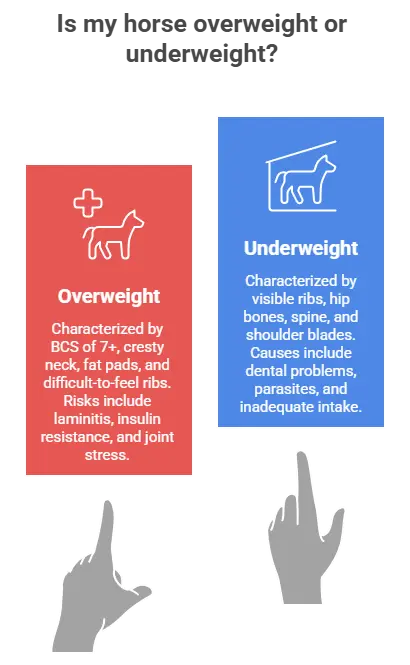
Yes and both conditions are common in domestic horses, for very different reasons. Understanding the causes and risks of both extremes is essential for responsible horse ownership.
Overweight Horses
Obesity in horses is a growing problem in the Western world, driven largely by domestication patterns that restrict natural movement and overestimate nutritional needs. A horse that lives in a small paddock, receives unlimited access to rich pasture or hay, and does little to no work is at significant risk of becoming overweight.
The health consequences of equine obesity include laminitis (inflammation of the hoof laminae), insulin resistance and metabolic syndrome, increased joint stress and early arthritis, reduced reproductive performance in mares, and greater surgical and anesthetic risk.
Overweight horses can be identified by a BCS of 7 or above, visible fat deposits along the crest of the neck (a condition called a cresty neck), fat pads behind the shoulder and around the tailhead, and ribs that are very difficult or impossible to feel.
Underweight Horses
An underweight horse has insufficient body fat and often insufficient muscle mass to maintain normal physiological function. In severe cases, the horse’s ribs, hip bones, spine, and shoulder blades are clearly visible from a distance.
Common causes of horses becoming underweight include dental problems that prevent proper chewing and digestion of feed, heavy parasite burdens, competition for feed in a herd environment, inadequate caloric intake for the horse’s workload level, chronic pain that reduces feed intake, and serious underlying health conditions including cancer, liver disease, or Cushing’s disease.
How to Help an Underweight Horse Gain Weight
Weight gain in horses should always be gradual — rapid refeeding after severe starvation can cause serious metabolic complications. The correct approach is to start with high-quality forage, increase calories slowly over several weeks, add digestible energy sources like rice bran or high-fat feeds under veterinary guidance, and address the underlying cause of weight loss simultaneously.
A horse recovering from malnourishment should be evaluated by a veterinarian to rule out parasites, dental disease, and metabolic conditions before a refeeding program begins.
How to Help an Overweight Horse Lose Weight
Controlled weight loss in horses requires reducing caloric intake while maintaining adequate nutrition and fiber intake. Strategies include restricting pasture access using a grazing muzzle, replacing rich hay with mature grass hay that is lower in sugar and calories, increasing exercise to raise caloric expenditure, and eliminating unnecessary grain from the diet.
Important Note: Never put a horse on a complete fast or severely restricted diet to achieve rapid weight loss. Horses that go without adequate forage for extended periods are at serious risk of developing hyperlipemia — a dangerous condition where fat is mobilized from the liver at a rate that overwhelms the body’s ability to process it. This condition can be fatal, particularly in ponies and miniature horses.
Seasonal Weight Changes in Horses
One aspect of horse weight management that many owners overlook is the natural seasonal variation that horses experience as part of their biological rhythm. Horses are not designed to maintain a perfectly stable weight year-round — they evolved to gain weight during summer when pasture is rich and lose weight during winter when forage is scarce.
During spring and summer, horses typically gain weight as lush pasture becomes available. This seasonal gain is natural and healthy for most horses, though it must be monitored carefully in horses prone to laminitis or metabolic syndrome, for whom the high sugar content of spring grass poses a genuine health risk.
During late autumn and winter, horses naturally lose some body condition, particularly in regions with cold climates where energy is diverted to thermoregulation. A BCS drop of 0.5 to 1 point over winter is generally not a concern in a healthy horse. A drop of more than 1.5 points warrants dietary adjustment and veterinary evaluation.
Tracking weight monthly throughout the year gives you the ability to anticipate and manage these seasonal fluctuations proactively rather than reacting to them once the horse is already significantly over or underweight.
How Weight Affects Performance and Riding
For riding horses, the relationship between body weight and athletic performance is direct and significant. A horse that is carrying excess body fat has to work harder to perform the same tasks as a well-conditioned horse at optimal weight. The excess weight places additional strain on the cardiovascular system, increases heat production, and puts greater load on the joints with every stride.
Conversely, a horse that is too thin lacks the muscle mass and energy reserves necessary for sustained athletic performance. It will tire more quickly, recover more slowly between training sessions, and be more susceptible to injury.
For competitive disciplines, weight management is taken extremely seriously. Racehorses, eventers, and endurance horses are typically maintained at the leaner end of the healthy BCS range (4.5 to 5.5) to optimize their power-to-weight ratio and stamina.
Rider Weight and the 20 Percent Rule
The rider’s weight relative to the horse’s weight is an important consideration that is frequently underestimated. The widely accepted guideline established by equine research is that total rider and tack weight should not exceed 20 percent of the horse’s body weight for sustained riding.
For a 1,000 lb horse, this means the combined weight of rider and saddle should not exceed 200 lbs. For a 1,400 lb warmblood, the safe limit rises to 280 lbs. Heavier riders are not excluded from riding — they simply require proportionally heavier horses to maintain this safe ratio and protect the horse’s long-term soundness.
How Are Horses Weighed? 4 Methods Explained
Knowing that you need to weigh your horse is one thing. Knowing how to do it accurately is another. There are four main methods used to measure horse weight, each with different levels of accuracy and practicality.
Method 1 — Livestock Scale (Most Accurate)
A certified livestock scale provides the most accurate horse weight measurement available. Large animal veterinary clinics, equine hospitals, and some equestrian centers and feed stores have walk-on livestock scales that horses can be led across.
The reading is immediate, precise to within a few pounds, and requires no calculation. If you can access a livestock scale, this is always the best option — particularly for horses on medication, horses with known health conditions, and horses whose weight you need to track precisely over time.
The main limitation is accessibility. Not every horse owner lives near a facility with a livestock scale, making it impractical for frequent monitoring.
Method 2 — Weight Tape Method
A weight tape is a flexible measuring tape marked with weight estimates that is placed around the horse’s girth at the widest point of the barrel, just behind the front legs. The tape reads an estimated weight directly without any calculation required.
Weight tapes are inexpensive, widely available at tack shops, and easy to use without assistance. They are accurate to within approximately 50 to 100 lbs for horses of average proportions — sufficient for feed management and general monitoring.
The main limitation is that weight tapes are calibrated for horses of average body proportions. They tend to underestimate the weight of very heavy or muscular horses and can overestimate the weight of very lean or fine-boned horses.
Method 3 — Heart Girth Formula
The heart girth formula uses two body measurements to calculate an estimated weight. This method is more accurate than a weight tape alone and works well for horses of unusual proportions.
The formula is:
Weight (lbs) = (Heart Girth in inches x Heart Girth in inches x Body Length in inches) divided by 330
To use this formula, measure the heart girth (the circumference around the horse’s barrel just behind the front legs) and the body length (measured from the point of shoulder to the point of buttock). Insert both measurements into the formula to get the estimated weight.
As a practical example — a horse with a heart girth of 72 inches and a body length of 68 inches would calculate as: (72 x 72 x 68) divided by 330 = 352,224 divided by 330 = approximately 1,067 lbs.
This method is accurate to within 3 to 5 percent for most horses, making it reliable enough for medication dosing when a livestock scale is not available.
Important Note: Always use the same measurement method consistently when tracking weight over time. Switching between a weight tape and the heart girth formula between measurements introduces inconsistency that makes it impossible to accurately track changes in your horse’s weight and condition.
Method 4 — Digital Weight Estimator Apps
Several mobile applications are now available that use smartphone cameras and AI-based image analysis to estimate horse weight from photographs. The user takes photos of the horse from specific angles and the app calculates an estimated weight based on body measurements derived from the images.
These apps are improving in accuracy but are not yet considered reliable enough for medication dosing decisions. They are best used as a supplementary tool or a convenient first estimate rather than a primary weight measurement method.
What Factors Affect How Much a Horse Weighs?
Beyond breed, a horse’s actual weight at any given time is influenced by a combination of biological, environmental, and management factors.
Breed and Genetics
Genetics establishes the structural framework — the skeletal size, bone density, and muscling potential — that determines a horse’s weight range. A well-fed Arabian will never weigh as much as a well-fed Belgian Draft because their genetic blueprints are fundamentally different. Breed is the ceiling and floor of weight potential.
Age and Growth Stage
As discussed in the weight-by-age section, horses gain weight progressively from birth through maturity. Beyond maturity, age continues to influence weight in a different way. Senior horses aged 18 and older commonly lose body condition due to decreased digestive efficiency, dental deterioration, and reduced absorption of nutrients. Regular weight monitoring becomes even more important as horses enter their senior years.
Sex and Hormonal Factors
Stallions are typically heavier than mares and geldings of the same breed due to higher muscle mass driven by testosterone. Mares may experience weight fluctuations related to reproductive cycles, pregnancy, and lactation. A pregnant mare in late gestation carries significant additional weight from the foal, placenta, and increased fluid volume — typically an extra 100 to 200 lbs in the final months before foaling.
Diet and Nutrition Quality
The quality, quantity, and balance of a horse’s diet directly determines its body weight and condition. Horses fed high-quality hay with balanced grain supplementation maintain better weight than those on poor-quality forage regardless of the volume consumed. Protein, fat, and digestible energy content of the diet are the primary drivers of weight maintenance and change.
Exercise and Muscle Development
A horse in regular athletic training develops greater muscle mass than an unworked horse of the same breed. This increased muscle mass adds to total body weight while simultaneously improving body composition — replacing fat with functional tissue. A fit performance horse at 1,200 lbs may actually carry more functional body mass than an unfit horse at the same weight.
Health Conditions and Illness
Numerous health conditions directly affect horse weight, both positively and negatively. Cushing’s disease, insulin resistance, and hypothyroidism are associated with abnormal weight gain and fat distribution. Parasitism, dental disease, ulcers, liver disease, and chronic pain conditions are associated with weight loss. Any unexplained change in horse weight should trigger veterinary evaluation to rule out underlying health issues.
Famous Racehorses and Their Weights
For context and engagement, it is interesting to look at what some of the most famous racehorses in history actually weighed since many people assume champion racehorses must be exceptionally large.
Secretariat, widely considered the greatest racehorse in history and the 1973 Triple Crown winner, weighed approximately 1,175 lbs (533 kg) at his racing peak. His heart, revealed during autopsy, was estimated to be two to three times the normal size a genetic anomaly believed to contribute to his extraordinary cardiovascular capacity.
Man o’ War, the legendary American Thoroughbred of the early 20th century, reportedly weighed around 1,150 lbs (520 kg) in racing condition. Frankel, the undefeated British champion trained by Sir Henry Cecil, raced at approximately 1,200 lbs (545 kg).
These weights confirm that champion racehorses are not the heaviest horses — they are the most efficiently conditioned horses, carrying precisely the body mass that maximizes their speed and endurance within the Thoroughbred breed standard.
Frequently Asked Questions
How much do horses weigh on average?
The average adult horse weighs between 900 and 1,200 pounds (410 to 545 kg), depending on breed and body condition. This range represents the most common light horse and stock horse breeds. Draft horses are significantly heavier, averaging 1,800 to 2,400 lbs, while ponies range from 400 to 900 lbs. The globally accepted figure for a “typical” horse is approximately 1,000 to 1,100 lbs.
How much does a racehorse weigh?
Most Thoroughbred racehorses weigh between 1,000 and 1,200 pounds (450 to 545 kg) in racing condition. Racehorses are lean and highly conditioned, so they tend to sit at the lighter end of the Thoroughbred weight range. Quarter Horse racehorses are typically heavier, averaging 1,100 to 1,300 lbs, due to their stockier, more muscular build compared to Thoroughbreds.
How much does a newborn horse weigh?
A newborn foal typically weighs between 100 and 200 pounds (45 to 90 kg) at birth. As a general guideline, foals are born at approximately 10 percent of their dam’s body weight. A foal born to a 1,100 lb mare will typically weigh around 110 lbs. Draft horse foals are heavier at birth, often exceeding 200 lbs, reflecting the larger size of the parent breeds.
How much does a draft horse weigh?
Draft horses are the heaviest horses in the world, averaging between 1,800 and 2,400 pounds (815 to 1,090 kg). The Shire and Belgian Draft are among the heaviest breeds, with large individuals regularly exceeding 2,200 lbs. The heaviest horse ever recorded was a Shire named Mammoth, who weighed 3,360 lbs (1,524 kg) in 1850 — a record that still stands today.
How much does a pony weigh?
Ponies weigh between 400 and 900 pounds (180 to 410 kg) depending on breed and size. Shetland Ponies at the small end average 400 to 500 lbs, while larger pony breeds like the Connemara range from 700 to 900 lbs. Despite their smaller size, ponies are proportionally heavier and stronger than many full-sized horses and are known for their exceptional strength relative to their body weight.
How do I weigh my horse without a scale?
The most reliable method without a scale is the heart girth formula: multiply the heart girth measurement (in inches) by itself, then multiply that result by the body length (in inches), then divide the total by 330. This gives an estimated weight in pounds accurate to within 3 to 5 percent. A weight tape is a quicker alternative and is accurate enough for general management purposes, though less precise than the formula method.
How does horse weight affect medication dosing?
Nearly all equine medications are dosed in milligrams per kilogram of body weight. An incorrect weight estimate directly leads to incorrect dosing either underdosing, which reduces treatment effectiveness and can contribute to drug resistance in parasites, or overdosing, which risks toxicity and organ damage. Accurate weight measurement is especially critical for dewormers, sedatives, antibiotics, and anti-inflammatory medications like phenylbutazone.
What is a healthy weight for a horse?
A healthy weight for a horse is breed-specific and best assessed using both a numeric weight measurement and a Henneke Body Condition Score of 4.5 to 6. Within this BCS range, the horse’s ribs cannot be seen but can be easily felt, there are no prominent fat deposits, and the horse has adequate muscle tone. The specific weight that corresponds to this condition varies by breed and individual frame size.
Veterinary Disclaimer: The weight ranges and health information provided in this article are intended for general educational purposes only. Every horse is an individual and weight management decisions particularly those involving medication dosing, dietary changes, or treatment of health conditions should always be made in consultation with a licensed equine veterinarian.