As modern horse management increasingly relies on stabling for training, competition, biosecurity, and climate control, equine welfare experts are renewing calls for better environmental enrichment inside the stable. At the center of this discussion are hayfeeders and enrichment tools, now widely recognized as practical, evidence-based solutions for improving the physical health, mental wellbeing, and behavioral balance of stabled horses.
Recent research and on-farm observations show that relatively simple changes—such as slow-feed hay systems, forage-based enrichment, and interactive stable tools—can significantly reduce stress, digestive disorders, and stereotypic behaviors in horses that spend extended time indoors.
The Welfare Challenge of Stabling Horses
Horses evolved as grazing animals, designed to move continuously and eat small amounts of forage for most of the day. In natural conditions, horses may spend 14 to 18 hours daily foraging, interspersed with steady movement and social interaction.
In contrast, stabled horses often experience:
- Limited feeding periods
- Long gaps without forage
- Reduced movement
- Social isolation
- Predictable, monotonous routines
According to welfare specialists, this mismatch between natural behavior and managed environments is a key contributor to common stable-related problems such as gastric ulcers, boredom, anxiety, and repetitive behaviors like weaving or cribbing.
Hayfeeders: Reintroducing Natural Foraging Behavior
What Are Hayfeeders?
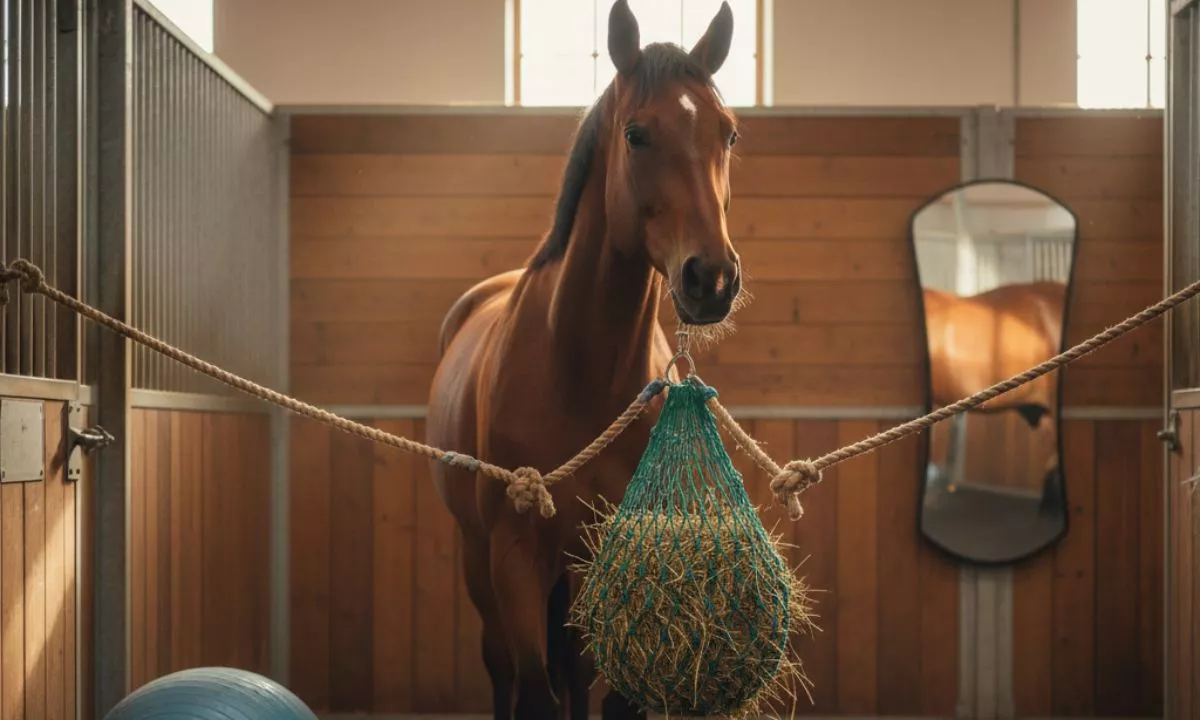
Hayfeeders are feeding systems designed to slow down forage intake and extend eating time. Common formats include:
- Small-hole slow-feed hay nets
- Ground-level hay boxes with grids
- Hanging hay bags
- Rolling hay feeder balls
Unlike traditional open piles of hay, these systems require the horse to work gradually for forage, mimicking grazing behavior.
Health Benefits of Hayfeeders
Research consistently shows that slow-feeding systems offer multiple health advantages:
1. Improved Digestive Health
Continuous access to forage helps maintain a steady flow of saliva, which buffers stomach acid and lowers the risk of equine gastric ulcer syndrome (EGUS).
2. Reduced Colic Risk
Slower intake prevents sudden overloads of dry forage and supports more stable gut motility.
3. Weight Management
For easy keepers, hayfeeders allow longer eating time without increasing calorie intake—particularly when paired with lower-calorie forage.
4. Improved Time Budgets
Studies show that horses using hayfeeders spend significantly more time eating and less time standing idle, aligning behavior more closely with free-ranging horses.
Behavioral Impact: Less Stress, Fewer Stereotypies
One of the most significant welfare improvements associated with hayfeeders is a reduction in frustration-related behaviors.
Stabled horses with unrestricted or extended forage access show:
- Less pawing and kicking
- Reduced weaving and box walking
- Lower levels of oral stereotypies
- More relaxed postures and resting behavior
Equine behaviorists note that forage deprivation is a primary trigger for stereotypic behavior. Hayfeeders directly address this issue by eliminating long periods without food.
Beyond Hay: Enrichment Tools for Mental Stimulation
While forage-based enrichment is foundational, experts emphasize that mental stimulation is equally important—especially for performance horses on restricted turnout.
Popular Stable Enrichment Tools
1. Treat and Activity Balls
Durable balls that dispense small amounts of feed or encourage nudging and exploration help break monotony and promote light physical activity.
2. Stable Mirrors
Specially designed, shatter-resistant mirrors can reduce stress in isolated horses by providing visual companionship. Some horses show measurable reductions in weaving and calling behaviors.
3. Hanging Toys and Chew Items
Safe, horse-specific toys provide sensory stimulation and can redirect oral behaviors away from stall fixtures.
4. Multi-Point Feeding Systems
Using more than one hayfeeder location within a stall encourages movement and exploration, even in confined spaces.
Physiological Responses: Engagement Without Distress
Importantly, enrichment does not simply increase activity—it promotes positive engagement. Studies measuring heart rate and behavioral indicators show that enriched horses display:
- Mild increases in heart rate linked to curiosity and interaction
- No corresponding rise in stress hormones
- Faster return to relaxed baseline states
This distinction matters. Welfare specialists emphasize that enrichment should stimulate without overstimulating, offering choice and control rather than forced activity.
Timing Matters: When Enrichment Is Most Effective
Research indicates that enrichment tools have the greatest impact:
- Between meals, when anticipation and frustration are highest
- During overnight stabling
- During box rest or injury rehabilitation
- In competition environments with limited turnout
By filling these high-risk periods with structured enrichment, caretakers can prevent welfare problems before they emerge.
Adoption Across the Industry
Hayfeeders and enrichment tools are no longer confined to progressive private yards. They are increasingly adopted by:
- Professional training barns
- Competition venues
- Rehabilitation centers
- Veterinary hospitals
- Welfare-focused breeding operations
Major equestrian welfare organizations and veterinary institutions now include enrichment as part of best practice stable management guidelines, reflecting a broader shift toward evidence-based horse care.
Practical Considerations for Owners and Barn Managers
Experts stress that enrichment should be individualized and monitored.
Best-Practice Guidelines
- Introduce new tools gradually
- Monitor for entanglement risks with hay nets
- Rotate enrichment items to maintain novelty
- Adjust forage type and hole size based on dental health
- Observe each horse’s response and preferences
Not all horses respond the same way. Some engage heavily with toys, while others prefer forage-based enrichment alone.
Welfare Is Not a Luxury—It’s a Management Standard
Equine scientists increasingly reject the idea that enrichment is optional or cosmetic. Instead, it is now viewed as a core welfare requirement for horses kept in confined environments.
Hayfeeders and enrichment tools offer a rare advantage in horse management: they are low-cost, low-risk, and high-impact. By addressing both physical and psychological needs, they help stabled horses remain healthier, calmer, and better equipped to perform.
Looking Ahead
As equestrian sport and horse ownership continue to evolve, welfare expectations are rising. Hayfeeders and enrichment tools represent a tangible way to align modern management with the horse’s natural biology—without compromising training goals or operational efficiency.
For stabled horses around the world, these simple tools are proving that better welfare does not always require radical change—sometimes, it just requires letting horses eat, move, and think a little more like horses.