Executive Summary
Equine gastric ulcer syndrome (EGUS) is best understood as a management-driven condition rather than an unpredictable disease process (Sykes et al., 2015). Horses secrete gastric acid continuously, and protection of the stomach—particularly the vulnerable squamous region—depends on consistent forage intake, adequate chewing-induced saliva buffering, and sufficient physical stomach fill that supports horse stomach acid control (Murray, 2013).
Introduction
Horse gastric ulcers and stomach ulcers in horses rarely arise from a single event. In most cases, ulcers in horses develop gradually due to repeated feeding patterns such as extended forage gaps, inconsistent horse feeding schedules, or poor forage structure that limits chewing and saliva production (Sykes et al., 2015; Murray, 2013). Many horses appear outwardly healthy while experiencing ongoing gastric irritation that later manifests as reduced appetite, girthiness, altered behavior, or inconsistent performance (Andrews et al., 2007).
Understanding the Equine Stomach and Ulcer Risk
To apply feeding strategies effectively, it is essential to understand how ulcer risk develops within the equine stomach. The stomach consists of two functionally distinct regions. The upper squamous region lacks a mucus–bicarbonate barrier and is therefore highly susceptible to acid injury, resulting in equine squamous gastric disease (ESGD). The lower glandular region secretes acid but is protected by mucus, bicarbonate secretion, and blood flow; ulceration here is classified as equine glandular gastric disease (EGGD) (Sykes et al., 2015).
How Hay Type Affects Stomach Ulcer Risk
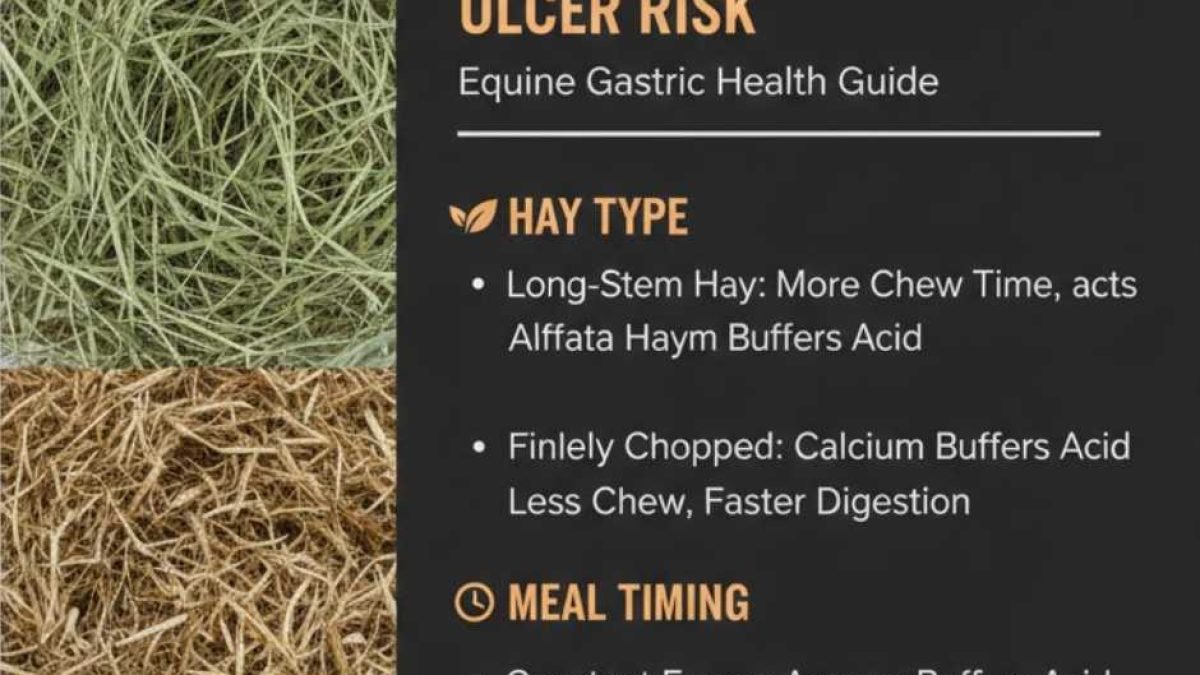
Long-Stem Grass Hay and Gastric Protection
Grass hay for horses, including timothy, orchardgrass, bermuda, brome, and mixed grass hays, remains the cornerstone of ulcer-protective feeding programs. Its primary value lies in fiber length and physical structure rather than nutrient composition alone. Long-stem hay requires prolonged chewing, which stimulates saliva production and delivers bicarbonate buffering to the stomach, supporting gastric health in horses (Murray, 2013).
Alfalfa Versus Grass Hay: Strategic Buffering Considerations
Alfalfa hay for horses differs from grass hay in both chemical and functional properties. Its higher calcium and protein content contributes to increased buffering capacity within the stomach, raising gastric pH (Nadeau et al., 2000). Controlled studies demonstrate that alfalfa hay inclusion can reduce the severity of squamous ulcers in exercising horses when compared with certain grass-hay-based diets, supporting its role in ulcer-friendly diets (Lybbert et al., 2007).
Forage Quality, Processing, and Ulcer Risk
Hay quality and ulcers are closely linked. Dusty, mold-contaminated, or overly mature hay may reduce voluntary intake and chewing consistency, indirectly increasing ulcer risk (Andrews et al., 2007). Processed forage forms such as pellets, cubes, or finely chopped hay are often consumed rapidly and provide less chewing stimulation, reducing saliva buffering and stomach fill (Sykes et al., 2015)
Practical Feeding Adjustments That Reduce Ulcer Risk
Across professional training barns and breeding operations, ulcer risk often decreases when feeding systems are redesigned rather than supplemented (Murray, 2013). Extending overnight hay availability using controlled slow-feeding methods reduces forage gaps in horses without increasing total intake. Practitioners commonly report improved appetite consistency, calmer behavior, and fewer indicators of gastric discomfort following these changes (UC Davis, 2025).
Conclusion
Hay type for horses and meal timing in horses function as foundational control variables in managing stomach ulcer risk in horses (Sykes et al., 2015). Long-stem forage, adequate chewing time, and predictable feeding intervals reduce gastric acid exposure and support mucosal integrity, forming the basis of effective ulcer prevention in horses (Murray, 2013).
Frequently Asked Questions
Q1: Which hay reduces ulcer risk the most?
A: Long-stem grass hay provides the most consistent protection against ulcers, while alfalfa hay offers additional buffering benefits when used strategically (Nadeau et al., 2000; Lybbert et al., 2007).
Q2: How long can a horse go without hay before ulcers become likely?
A: Forage gaps exceeding approximately six hours are consistently associated with increased gastric ulcer risk in horses (Sykes et al., 2015; UC Davis, 2025).
Q3: Does alfalfa really buffer stomach acid?
A: Yes. Research shows that alfalfa’s mineral and protein profile can raise stomach pH and reduce squamous ulcer severity when fed in hay form and timed appropriately (Nadeau et al., 2000).
Call to Action
Review your horse feeding routine with ulcer prevention in mind. Identify forage gaps exceeding six hours, assess hay type and quality, and implement pre-exercise forage feeding where appropriate (Sykes et al., 2015). For horses showing persistent discomfort or performance inconsistency, veterinary consultation and continued engagement with evidence-based equine digestive health resources are recommended.
References
- Andrews, F. M., Buchanan, B. R., Smith, S. H., Elliott, S. B., & Saxton, A. M. (2007). Gastric ulcers in horses. Journal of Animal Science, 85(13), 312–318.
- Lybbert, T., Gibbs, P. G., Cohen, N. D., & Walker, K. C. (2007). Feeding alfalfa hay to exercising horses reduces the severity of gastric squamous mucosal ulceration. Journal of Equine Veterinary Science, 27(8), 360–365.
- Murray, M. J. (2013). Equine gastric ulcer syndrome. Equine Veterinary Education.
- Nadeau, J. A., Andrews, F. M., Mathew, A. G., Argenzio, R. A., Blackford, J. T., & Sohtell, M. (2000). Evaluation of diet as a cause of gastric ulcers in horses. American Journal of Veterinary Research, 61(7), 784–790.
- Sykes, B. W., Hewetson, M., Hepburn, R. J., Luthersson, N., & Tamzali, Y. (2015). European College of Equine Internal Medicine consensus statement—Equine gastric ulcer syndrome in adult horses. Journal of Veterinary Internal Medicine, 29(5), 1288–1299.
- UC Davis Center for Equine Health. (2025). Understanding equine gastric ulcers. Horse Report.
- Whitfield-Cargile, C. M., et al. (2022). Diet-driven modulation of the equine gut microbiome and metabolome. Frontiers in Veterinary Science.