Introduction
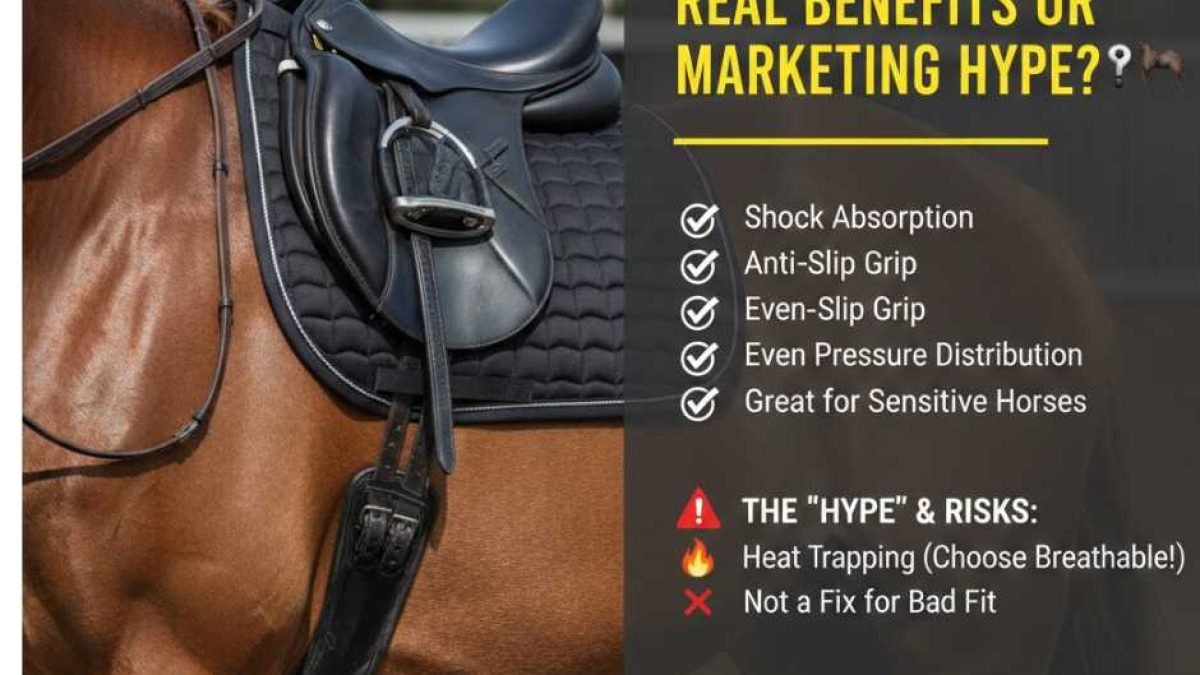
Gel saddle pads appear in almost every tack catalogue, often promoted with bold claims: exceptional shock absorption, instant comfort, and “game-changing” performance. Riders see images of translucent pads promising to protect the horse’s back and stabilise the saddle in any situation. The question is simple but important: how much of this is genuinely helpful, and how much is clever marketing?
What Is a Gel Saddle Pad?
A gel saddle pad uses a flexible polymer gel as the primary functional layer. The gel may appear as a solid slab, a perforated sheet, or a honeycomb-like structure. When weight is applied, the gel deforms—spreading forces sideways and adjusting shape under the saddle panels. Many gel pads also have a slightly tacky surface, which improves grip between the saddle and the pad, and between the pad and the horse.
Real Benefits of Gel Saddle Pads
Impact Damping for High-Impact Work
One of gel’s genuine strengths is impact damping. When the rider sits, posts, or lands over a fence, the gel layer deforms and absorbs part of the energy that would otherwise travel directly through the saddle panels to the horse’s back. Instead of a sharp, concentrated peak, the impact is spread over a slightly longer time and a wider area.
This can be especially useful in:
- Jumping and cross-country, where landings are more intense.
- Horses with naturally sensitive backs that react strongly to jarring forces.
- Riders who spend significant time in sitting trot or other high-load work.
Supporting Saddle Stability
The slightly tacky nature of many gel pads provides non-slip behaviour. A thin gel layer placed between the saddle and a regular pad—or between the pad and the horse—can help the saddle stay centred, particularly on horses with round barrels, low withers, or very smooth coats.
Stability matters. A saddle that shifts or rolls creates fluctuating pressure zones and friction, which can contribute to discomfort and resistance. When used correctly, a slim gel pad can:
- Reduce sideways movement on round backs.
- Minimise backward creep on inclined backs.
- Assist with stability during dynamic movements such as jumping or lateral work.
Thin Profile Options for Good-Fitting Saddles
Another genuine advantage of many modern gel saddle pads is the availability of thin, low-profile designs. Unlike thick foam or bulky fleece, a thin gel pad can offer additional impact moderation and grip without substantially changing saddle balance—provided the pad is truly slim and well designed.
Where Gel Pads Can Fall Short
Heat Build-Up and Poor Ventilation
Gel itself does not breathe. In solid or very thick forms, it can trap heat and sweat against the horse’s back. In warm conditions or long sessions, this can make the back hotter and more uncomfortable, potentially increasing the risk of irritation or sweat scald if the pad is not combined with appropriate fabrics.
- Ride duration and intensity.
- Climate and arena conditions.
- How hot and damp the horse’s back feels under the pad after work.
Gel Migration and “Bottoming Out”
Under sustained load and movement, some gel pads can displace away from high-pressure areas, a behaviour sometimes described as “bottoming out.” Over a long ride, the gel may move laterally, leaving thinner support directly under the most loaded points while pooling in lower-pressure regions.
Weight and Bulk in Some Designs
While many modern gel pads are thin and relatively light, some older or lower-cost designs are noticeably heavy and thick. Adding a heavy slab of gel under the saddle has two main drawbacks:
- Extra weight on the horse’s back.
- Increased bulk that can alter the saddle’s effective width and balance, particularly on already snug saddles.
When Gel Is a Logical Choice
Gel is most logically chosen when:
- The saddle has been reasonably fitted.
- The work includes higher impact phases, especially jumping.
- Stability is a challenge on certain conformations.
- The rider wants a thin, additional buffer without making major fit changes.
Gel Saddle Pads vs Marketing Hype
There is real engineering behind gel materials, but marketing sometimes oversimplifies or exaggerates their capabilities. Common hype patterns include:
- Presenting gel pads as an automatic cure for all back issues.
- Suggesting that gel alone can replace professional saddle fitting.
- Implying that thicker is always better, without context about saddle balance or heat.
Conclusion and Call to Action
Gel saddle pads offer genuine benefits in impact damping, stability, and thin-profile protection when thoughtfully designed and used in the right context. They are not all hype—but they are not a universal solution either. The same material that can help in a fine-tuned setup can cause heat build-up, altered saddle balance, or false reassurance if applied without regard to fit and workload.
FAQs
Are gel saddle pads really better than foam or wool pads?
Not categorically. Gel pads can offer stronger impact damping and non-slip properties in certain contexts, particularly for jumping or stability issues. Wool and high-quality foams may be better for long-duration comfort and temperature regulation. The “better” option depends on your horse, saddle fit, workload, and climate.
Will a gel pad fix my horse’s back pain?
A gel pad might reduce the intensity of impacts or improve stability, which can help comfort in some cases. However, persistent back pain should always be investigated through saddle fitting and veterinary assessment. Gel is a support tool, not a diagnosis or cure.
Are all gel pads too hot for summer use?
Not all. Ventilated or honeycomb-style gel pads designed with airflow in mind are less likely to cause significant heat build-up than solid slabs. Even so, in very warm or humid conditions, you should monitor how hot and damp the back becomes and adjust pad choices accordingly.
Can I use a gel pad with any saddle?
You can physically place a gel pad under most saddles, but you should not assume it will always be beneficial. Saddles that are already snug may become effectively narrower with the addition of gel, especially if the pad is thick. Always reassess fit and clearance after adding any new pad layer.
Is a thicker gel pad always more protective?
No. A thicker pad can absorb more impact, but it also adds more bulk and can disrupt saddle balance or fill the gullet space if not carefully chosen. Slim, well-designed gel pads often represent a better balance between protection and fit integrity.