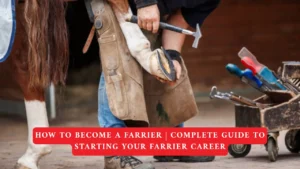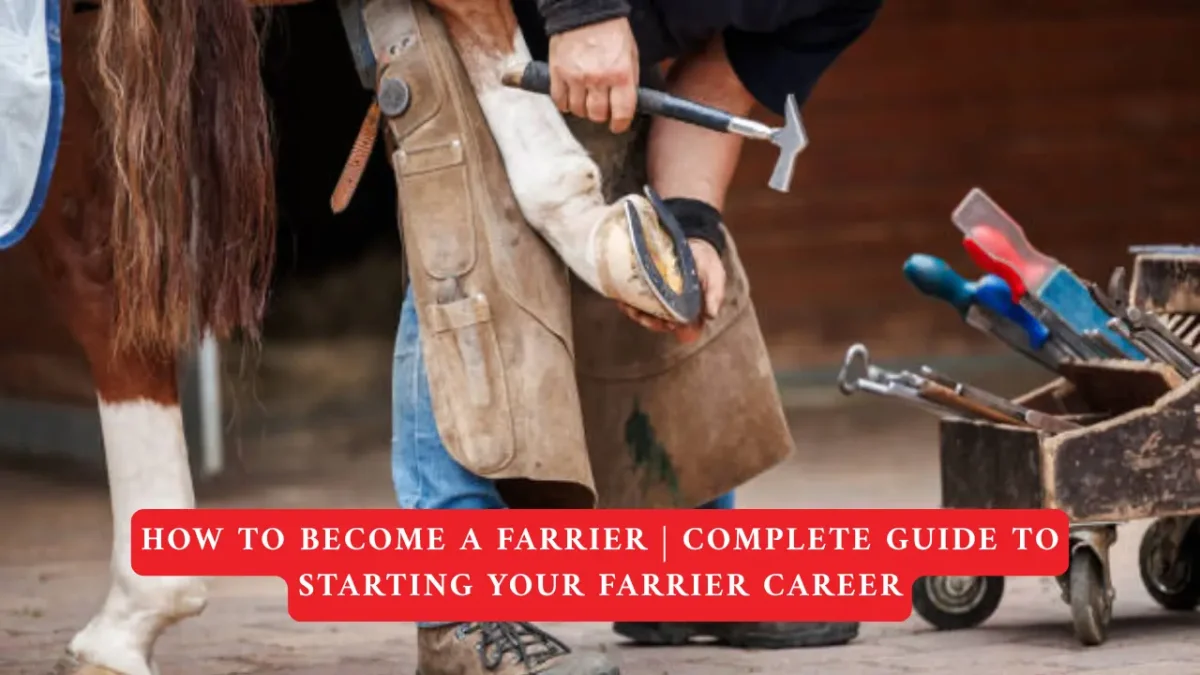
A farrier is a trained professional who trims balances, and shoes horses’ hooves, a role that sits at the intersection of animal science, skilled craftsmanship, and self employed business ownership.
With roughly 7.2 million horses in the United States (according to the American Horse Council) and each one requiring hoof care every six to eight weeks, farriers are among the most consistently in demand professionals in the equine industry. Yet across most regions of the country, the number of qualified farriers falls far short of the horses that need them.
For anyone considering a career working with horses that offers real independence, strong earning potential, and hands on work that directly impacts animal welfare, learning how to become a farrier is one of the most practical and rewarding paths available in 2026. But it is not a career to enter casually. The farrier profession demands serious physical conditioning, precision technical skill, confident horse handling ability, and the business discipline to manage your own clients, finances, and schedule from day one.
So what does it actually take to become a farrier? No college degree is required. No government licence is needed anywhere in the United States. Most farriers reach professional competency within 2 to 3 years by combining formal training at an accredited farrier school with a hands on apprenticeship under an experienced mentor.
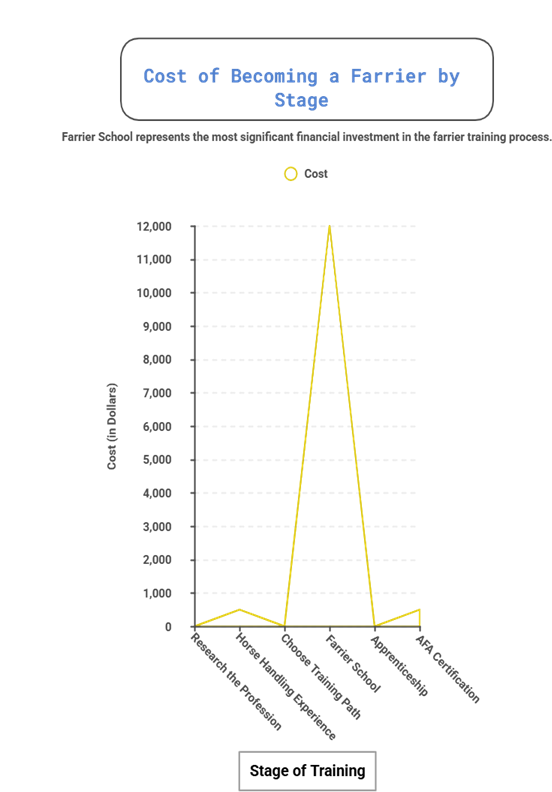
School tuition at established programmes ranges from $5,250 at Butler Professional Farrier School in Nebraska to $12,000 at Mission Farrier School in California. Once established, farrier income ranges from $35,000 to well over $100,000 per year, depending on location, specialisation, and how efficiently you run your business.
This guide covers everything you need to know about how to become a farrier in 2026, including the essential skills required, step by step training and certification paths, realistic costs and salary breakdowns, the tools and equipment you will need, what women entering the profession should know, and an honest assessment of whether this farrier career is the right fit for you.
Quick Summary: What Every Aspiring Farrier Should Know
- No formal degree is required but structured farrier training through an accredited school combined with apprenticeship is the proven path to professional competency
- Total timeline is 2 to 3 years with formal schooling (8 weeks to 12 months) plus 1 to 2 years of apprenticeship before full independence
- School tuition ranges from $5,250 to $12,000+ with additional investment needed for tools ($3,000 to $8,000) and a work vehicle
- AFA certification at three levels (CF, CTF, CJF) is voluntary but dramatically impacts earning potential and credibility
- Net farrier income after expenses typically ranges from $40,000 to $80,000+ with top specialists exceeding $100,000
- No federal or state licensing exists, making voluntary certification the most important professional differentiator
- Women make up approximately 6 to 10% of working farriers and the percentage is growing, with technique and precision valued over brute strength
- Physical fitness is career survival as back injuries are the leading cause of early retirement
Essential Skills and Qualities Needed to Become a Farrier
Before exploring the steps for how to become a farrier, you need to honestly assess whether you possess or can develop the qualities this trade demands. Passion for horses is important, but it is nowhere near sufficient on its own.
Physical Fitness and Stamina Requirements
Physical fitness and stamina are not optional advantages. They are baseline survival requirements. A farrier spends 4 to 8 hours per day bent over or squatting, holding a horse’s leg between their knees while trimming, rasping, and nailing shoes. Most work on 4 to 8 horses daily, with each horse taking 45 to 90 minutes.
The demands are specific: sustained lower back and core strength to hold position for 30 to 60 minutes per horse, powerful grip and upper body strength for driving nails and shaping steel, cardiovascular endurance to maintain precision across a full day of labour in all weather conditions, and healthy joints (knees, hips, shoulders) to withstand decades of repetitive bending and twisting.
Back injuries and joint degradation are the leading causes of early retirement in farriery. Proactive strength training and deliberate body mechanics awareness can add ten or more years to a working career. Begin conditioning before your first day of training, not after.
Manual Dexterity and Hand Eye Coordination
Every trim must achieve the correct hoof angle and medial lateral balance. Every nail must enter the hoof wall at a precise angle. Too deep, and you penetrate sensitive tissue, causing immediate pain and lameness. Manual dexterity and hand eye coordination separate a competent farrier from a dangerous one.
You will need to work confidently with both hands simultaneously, assess hoof symmetry by sight and touch, handle a full range of tools with instinctive precision, and make real time adjustments based on each horse’s unique anatomy and gait. Forge work, which involves heating, bending, and shaping steel on an anvil, adds a metalworking dimension that demands its own set of fine motor skills.
Animal Handling and Horsemanship Skills
You work directly beneath 1,200 pound animals of every temperament. Some stand quietly. Others kick, bite, lean on you, or panic without warning. Strong animal handling and horsemanship skills let you read a horse’s body language, anticipate reactions, and manage behaviour safely, protecting both you and the horse.
If you have limited experience around horses, this is the first skill to build, well before you invest money in any farrier school.
Business and Communication Skills
Approximately 90% of farriers are self employed. The farriers who fail financially are almost never the ones lacking technical skill. They are the ones who never learned to run a business.
You need client communication skills to explain hoof conditions and pricing to owners of all experience levels. You need scheduling discipline to manage a full route efficiently. You need financial literacy to track income, expenses, fuel, tool replacement, and quarterly taxes. And you need marketing ability, because in farriery, your reputation is built client by client, referral by referral.
A Day in the Life of a Working Farrier
Understanding the daily reality helps you decide if this career fits you. Here is what a typical working day looks like for a full time farrier:
5:30 AM Wake up and load the truck. Check tool inventory, confirm the day’s schedule, review notes on each horse.
7:00 AM First appointment at a private barn. Two horses, one routine trim (35 minutes), one full four shoe set with hot fitting (75 minutes). Chat with the owner about a slight medial flare on the mare’s left front.
9:30 AM Drive 25 minutes to a boarding facility. Three horses back to back. One is a known kicker who needs patience and careful positioning. Work through lunch.
1:00 PM Quick stop for fuel and food. Return client calls, confirm tomorrow’s schedule, send two invoices.
2:00 PM Afternoon appointment at a training barn. Two performance horses needing corrective shoeing for mild navicular changes. Consult with the barn’s veterinarian by phone about angle adjustments.
4:30 PM Final horse of the day at a backyard operation. Simple trim. Easy horse.
5:30 PM Drive home. Unload, clean and inspect tools, update client records, log mileage and expenses.
Total: 6 horses, roughly $800 to $1,100 gross revenue, 10+ hours including drive time.
That is a typical, not exceptional, day. Some days are harder. Some are shorter. Weather, difficult horses, equipment failures, and cancelled appointments all add unpredictability.
Step by Step Guide to Becoming a Farrier in 2026
Here is a practical, step by step roadmap for how to become a farrier in 2026. The most successful professional farriers follow a structured progression that builds knowledge, hands on skill, and professional credibility systematically.
Step 1: Research and Understand the Farrier Profession
Do not start with a tuition payment. Start by shadowing a working farrier for at least a full day, ideally across different settings. Ask specific questions: What is your annual gross revenue? What percentage goes to expenses? How many days per week do you work? What would you do differently if starting over? What is the hardest part that nobody warns you about?
Evaluate your local market. Are there enough horses within a reasonable drive radius? What do established farriers charge? ($80 to $160 per trim and shoe is the typical range in most US markets.) Are existing farriers turning away work, or competing for clients?
Assess your finances honestly. You will need $8,000 to $25,000 for training, tools, and vehicle setup before you earn your first dollar.
Step 2: Gain Basic Horse Handling Experience
Every reputable farrier school expects you to already be comfortable around horses. They teach horseshoeing, not horsemanship.
Spend a minimum of 3 to 6 months volunteering or working at a stable, riding school, or equine rescue. Focus specifically on groundwork including catching, leading, tying, grooming, and standing beside horses of different sizes and temperaments. Observe farrier appointments whenever possible. You want to arrive at school knowing how to read a horse’s body language and handle yourself safely, not learning these basics while also trying to learn a complex trade.
Step 3: Choose Your Training Path
| Training Path | Duration | Estimated Cost | Best For |
| Accredited farrier school | 8 weeks to 12 months | $5,250 to $12,000+ | Structured foundational knowledge |
| Apprenticeship | 1 to 3 years | Low or no cost | Real world volume and mentorship |
| School + apprenticeship | 1 to 2+ years | Varies | The gold standard (recommended) |
The combination approach is widely considered the best training path. School provides the structured foundation, covering anatomy, biomechanics, forge technique, and trimming principles, that is dangerous to skip. Apprenticeship builds the speed, adaptability, and clinical judgement that no classroom can replicate.
If budget forces a choice, start with school. A solid foundation prevents bad habits that become extremely difficult to correct later.
Step 4: Enroll in an Accredited Farrier School
Not all farrier schools are equal. Here are current tuition figures from established programmes to help you compare:
| School | Location | Duration | Tuition | Notable Details |
| Butler Professional Farrier School | Crawford, NE | 6 weeks | $5,250 | 86% graduation rate; tools to rent/purchase |
| Oklahoma Horseshoeing School | Purcell, OK | 8 to 12 weeks | $6,100 to $8,900 | Free housing and meals included |
| Pacific Coast Horseshoeing School | Plymouth, CA | 8 weeks | $8,000 | Taught by Intl Hall of Fame farrier |
| MSU Farrier School | Bozeman, MT | 12 weeks | $8,000 | University affiliated; VA benefits accepted |
| Oregon Farrier School | OR | 10 to 20 weeks | $10,000 to $17,500 | Final exam mirrors AFA CF exam |
| Mission Farrier School | CA | 8 weeks | $12,000 | Max 8 to 10 students; all materials included |
| Cornell University Farrier Program | Ithaca, NY | 16 weeks | Contact school | Within vet hospital; max 4 students (paused) |
When evaluating any accredited farrier school, prioritise: AFA affiliation or recognition, instructor certification level (Journeyman or higher), number of live horse practice hours versus classroom theory, class size (smaller is significantly better), and whether the programme helps graduates find apprenticeships.
Step 5: Gain Real World Experience through Apprenticeship
Graduating from school gives you a foundation. It does not make you a fully competent working farrier. A farrier apprenticeship bridges that gap through sheer volume of practice, real time mentorship, and exposure to the unpredictable variety of horses, hoof conditions, and client situations that no classroom can simulate.
To find an apprenticeship: leverage your farrier school’s alumni network and instructor connections, attend AFA conventions and regional clinics, contact established farriers directly in your target area with a professional inquiry, and demonstrate the qualities mentors look for, including punctuality, humility, physical readiness, and genuine commitment. Many experienced farriers receive apprenticeship requests regularly. Standing out requires professionalism, persistence, and proof that you have already invested in proper training.
Step 6: Obtain Farrier Certification
The American Farrier’s Association offers the most widely respected farrier certification in North America at three progressive levels:
- Certified Farrier (CF) requires one year of experience. Written and practical exam covering anatomy, trimming, shoeing, and a horseshoe display
- Certified Tradesman Farrier (CTF) requires CF completion plus two years of experience. Includes forging and fitting a handmade shoe within a time limit
- Certified Journeyman Farrier (CJF) is the highest level. Requires expert level forging of a therapeutic bar shoe to a specific pattern under strict time constraints
Can Women Become Farriers? Opportunities and Career Insights
Yes. And the data shows the trend is accelerating.
According to the American Farriers Journal Farrier Business Practices survey, approximately 6% of full time farriers and 10% of part time farriers are women. Zippia’s 2026 demographic data puts the overall figure at 26.6% female across all farrier related roles. While exact numbers vary by source and methodology, the direction is clear: women are entering farriery at higher rates than ever before.
In 2018, Cornell University’s farrier programme, one of the most selective in the country accepting only four students per session, admitted its first all female cohort. As the programme’s director Steve Kraus noted, the number of women in the industry has been growing steadily since the first woman entered the Cornell programme in 1972.
The physical demands are real but often misunderstood. As 2005 World Champion farrier James Blurton has stated, farriery is about technique and getting the horse to work with you, not a wrestling match. Many successful female farriers cite their superior horsemanship instincts, attention to detail, and client communication as competitive advantages. Butler Professional Farrier School has reported that some of their best students have been women, noting that empathetic horsemanship is a key trait for the ideal farrier regardless of gender.
Challenges remain, including initial scepticism from some horse owners and a smaller pool of female mentors. But these barriers are diminishing as more women earn certification, build visible practices, and demonstrate that skill and professionalism determine success. The International Association of Women Farriers provides mentorship and networking specifically for women in the trade.
Farrier Certification and Licensing Requirements
Understanding farrier certification and licensing requirements is essential for planning your career strategically.
American Farrier’s Association (AFA) Certification Process
The AFA certification process involves joining as a member to access study materials and testing opportunities, accumulating the required professional experience (one year minimum for CF), studying anatomy, physiology, pathology, and horseshoe applications using the AFA certification study guide, attending a Pre Certification Clinic for exam specific preparation, passing both written and practical examinations under certified examiners, and maintaining certification through continuing education credits.
The AFA is the oldest and largest national farrier organisation in North America and the only one offering internationally recognised competency standards. While voluntary, AFA certification carries substantial professional weight and is increasingly treated as the industry’s baseline standard of credibility.
State and Regional Licensing Requirements
The United States has no federal or state licensing requirements for farriers. Anyone can legally offer farrier services regardless of training or experience. This makes voluntary AFA certification the market’s primary quality signal and the reason certified farriers consistently command higher fees, receive more veterinary referrals, and attract higher quality clients.
Internationally, regulations differ significantly. In the UK, the Farriers Registration Act of 1975 makes it illegal to shoe horses without registration, which requires completion of a four year apprenticeship and formal examination. If you plan to practice internationally, research the specific licensing requirements of your target country well in advance.
Best Resources for Aspiring Farriers in 2026
Professional Farrier Associations and Organizations
The AFA is the primary national organisation offering certification, conventions, continuing education, and a “Find a Farrier” directory that helps certified members attract clients. The Brotherhood of Working Farriers Association (BWFA) offers alternative certification programmes and educational clinics. The International Association of Women Farriers provides targeted mentorship for women at every career stage. The AAEP (American Association of Equine Practitioners), while serving veterinarians, publishes invaluable resources on hoof pathology and lameness that directly benefit farriers seeking deeper clinical knowledge.
Recommended Books and Learning Materials
The core library every aspiring farrier should study includes: The Principles of Horseshoeing (P3) by Doug Butler, the foundational textbook of modern farrier education; A Textbook of Horseshoeing by A. Lungwitz and John W. Adams, a classic academic reference; the AFA Certification Study Guide, essential for anyone pursuing certification at any level; and Dollar Wise Horseshoeing by Doug Butler, one of the few resources dedicated to the business side of running a farrier practice.
Subscribe to American Farriers Journal for ongoing case studies, technique articles, tool reviews, and industry news. On YouTube, search for AFA convention footage, farrier competition videos, and school demonstration channels for free visual learning that supplements book study.
Networking and Mentorship Opportunities
The AFA Annual Convention is the largest professional gathering for farriers in North America, featuring live competitions, multi day clinics, a major trade show, and unmatched networking. Regional farrier competitions and clinics let you observe skilled professionals and build local relationships. Farrier school alumni networks facilitate ongoing mentorship and client referrals. Online communities including Facebook groups, YouTube channels, and dedicated forums provide daily access to peer advice and technique discussion. Attending equine veterinary conferences builds relationships with the vets who become your strongest referral source.
Start building your professional network during training, not after you are established. Early relationships provide apprenticeship opportunities, mentorship, and your first client referrals.
Tools and Equipment Every Farrier Needs
Your toolkit is your livelihood. Here is what you need and what it costs.
Hoof Trimming: 14 inch hoof nippers, hoof knives (right and left handed), 14 inch rasp, hoof testers, hoof pick.
Shoeing: Driving hammer, clinch cutter and block, pull offs, crease nail puller, pritchel, shoe spreader.
Forge and Anvil: Portable propane forge, 70 to 150 lb farrier anvil with horn, adjustable anvil stand, rounding and ball peen hammers, tongs in multiple sizes.
Safety: Leather farrier apron or chaps, safety glasses, hearing protection, steel toed slip resistant boots.
Vehicle: Reliable truck or van with custom tool storage, anvil mount, and forge platform.
Realistic Startup Costs:
| Category | Estimated Cost |
| Professional tool kit | $3,000 to $8,000 |
| Farrier school tuition | $5,250 to $12,000 |
| Work vehicle (used) | $8,000 to $25,000 |
| Vehicle customisation | $1,000 to $5,000 |
| Insurance (first year) | $500 to $1,500 |
| Living expenses during training (3 to 6 months) | $5,000 to $15,000 |
| Total estimated startup | $23,000 to $66,000 |
Most new farriers start with a basic kit and upgrade incrementally as income grows. Some schools, like Oklahoma Horseshoeing School, include tools in tuition or offer graduate discounts at affiliated supply stores, which can significantly reduce initial tool costs.
What a Farrier Actually Earns: Net Income Breakdown
Gross revenue numbers without expense context are misleading. Here is a realistic annual breakdown for an established full time farrier working 5 days per week, averaging 5 horses per day at $130 per horse:
| Category | Annual Amount |
| Gross revenue (5 horses x $130 x 250 days) | $162,500 |
| Minus: Fuel and vehicle maintenance | $12,000 |
| Minus: Horseshoes, nails, and supplies | $18,000 |
| Minus: Tool replacement and repair | $3,000 |
| Minus: Vehicle loan/lease payment | $6,000 |
| Minus: Liability and health insurance | $8,000 |
| Minus: Self employment taxes (15.3%) | $17,500 |
| Minus: Income taxes (estimated) | $18,000 |
| Net take home income | $80,000 |
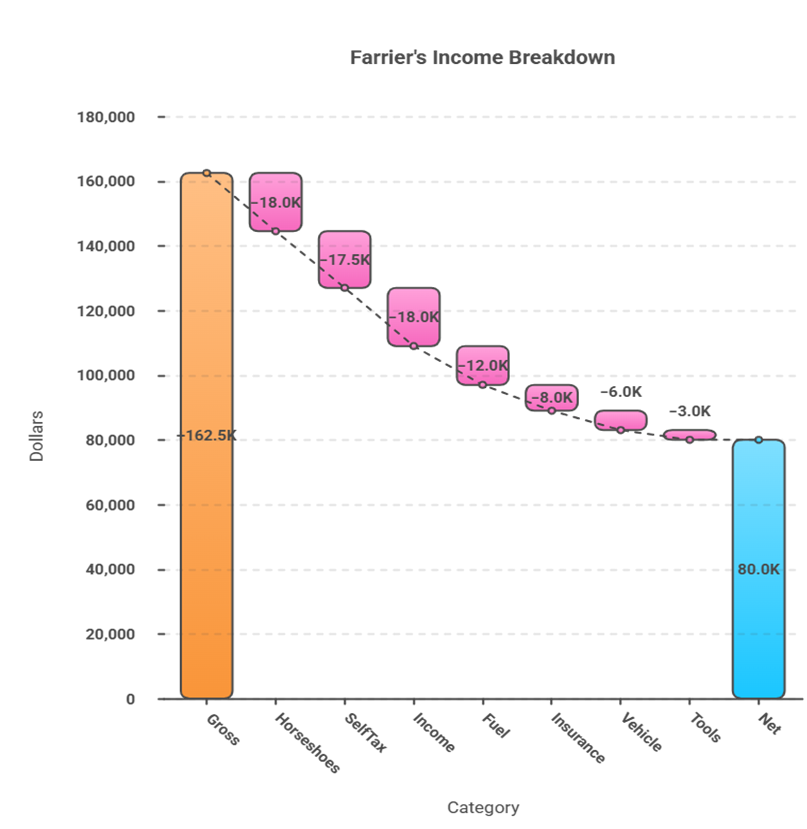
This is a strong year scenario for an experienced farrier with a full schedule. Early career farriers typically net $30,000 to $50,000 while building their client base. Farriers in high cost metro areas or specialising in racetrack and performance work can net significantly more. Farriers in rural areas with lower per horse rates may net less.
The key variable is not just skill. It is business efficiency. Minimising drive time, maintaining a full schedule, collecting payment promptly, and controlling expenses are what separate a $40,000 farrier from a $90,000 farrier.
Can You Become a Farrier at 30, 40, or Older?
Yes, and many successful farriers enter the profession as a second career. Farrier schools report significant enrolment from career changers in their 30s and 40s. Mission Farrier School has noted that some of their best graduates have been older students with no prior horse experience, because they bring maturity, work ethic, and life skills that younger students sometimes lack.
The honest consideration is physical longevity. A farrier who starts at 22 may have 30+ working years ahead. Someone starting at 40 realistically has 15 to 20 years before the cumulative physical demands become limiting. That is still a full career, but it makes proactive fitness, body mechanics training, and ergonomic tool choices even more important from day one.
Age also brings advantages: established financial stability to weather the lower income training period, maturity in client relationships, and often stronger business management skills than younger entrants. If you are physically fit, mentally committed, and willing to invest in the training properly, your age is not a barrier.
Frequently Asked Questions About Becoming a Farrier
How Long Does It Take to Become a Professional Farrier?
Formal farrier school programmes range from 8 weeks to 12 months. Add 1 to 2 years of apprenticeship for full professional competency. Total timeline is 2 to 3 years minimum. AFA Certified Farrier status requires at least one year of documented professional experience. Higher certifications require two or more years.
What Qualifications Are Required to Become a Farrier?
No degree, diploma, or licence is legally required in the United States. However, completing an accredited farrier school programme and earning AFA certification are increasingly expected by clients and veterinarians. The practical prerequisites that matter most are physical fitness, horse handling experience, manual dexterity, and work ethic.
How Much Does Farrier Training Cost?
School tuition ranges from $5,250 (Butler Professional Farrier School, 6 weeks) to $12,000 (Mission Farrier School, 8 weeks), with most programmes between $6,000 and $10,000. Some schools include housing and meals (Oklahoma Horseshoeing School offers both free). Budget an additional $3,000 to $8,000 for tools and $8,000 to $25,000 for a work vehicle. Total startup investment typically falls between $23,000 and $66,000.
Do Farriers Need Certification or a License?
No US law requires either. However, voluntary AFA certification is strongly recommended and increasingly treated as the professional baseline. Certified farriers earn more, attract better clients, and receive significantly more veterinary referrals. In the UK, farriery is legally regulated and requires formal registration after a four year apprenticeship.
What Is the Difference Between a Farrier and a Blacksmith?
A blacksmith is a general metalworker who forges iron and steel into tools, gates, and decorative items. A farrier specialises exclusively in equine hoof care, including trimming hooves, fabricating and fitting horseshoes, and managing hoof related health conditions. Farriers use blacksmithing techniques but also require deep knowledge of equine anatomy, biomechanics, and hoof pathology. They are separate professions with different training requirements and different knowledge bases.
Is a Farrier Career Right for You?
This career fits you if you are physically strong and committed to staying that way, comfortable around large unpredictable animals, drawn to hands on precision craftsmanship, self motivated enough to run your own business, and willing to invest 2 to 3 years before reaching full earning potential.
This career does not fit you if you have chronic back or joint issues, are uncomfortable around horses, strongly prefer a predictable salary with benefits, or are unwilling to pursue ongoing education and certification throughout your career.
The supply and demand math is straightforward: millions of horses need regular hoof care, and the number of qualified farriers entering the profession is not keeping pace with those retiring. According to the AFA, the average age of working farriers continues to rise, and the need for new professionals is acute. For someone with the right combination of physical ability, technical interest, and entrepreneurial drive, a farrier career offers genuine job security, strong income potential, and daily independence that very few professions can match.
Your real first step is not reading another article. It is experiencing the work firsthand. Visit the AFA school directory at americanfarriers.org to find accredited programmes near you, or use the AFA’s “Find a Farrier” tool to locate certified professionals in your area and ask to shadow them for a day. One day under a horse will tell you more than any guide ever could.