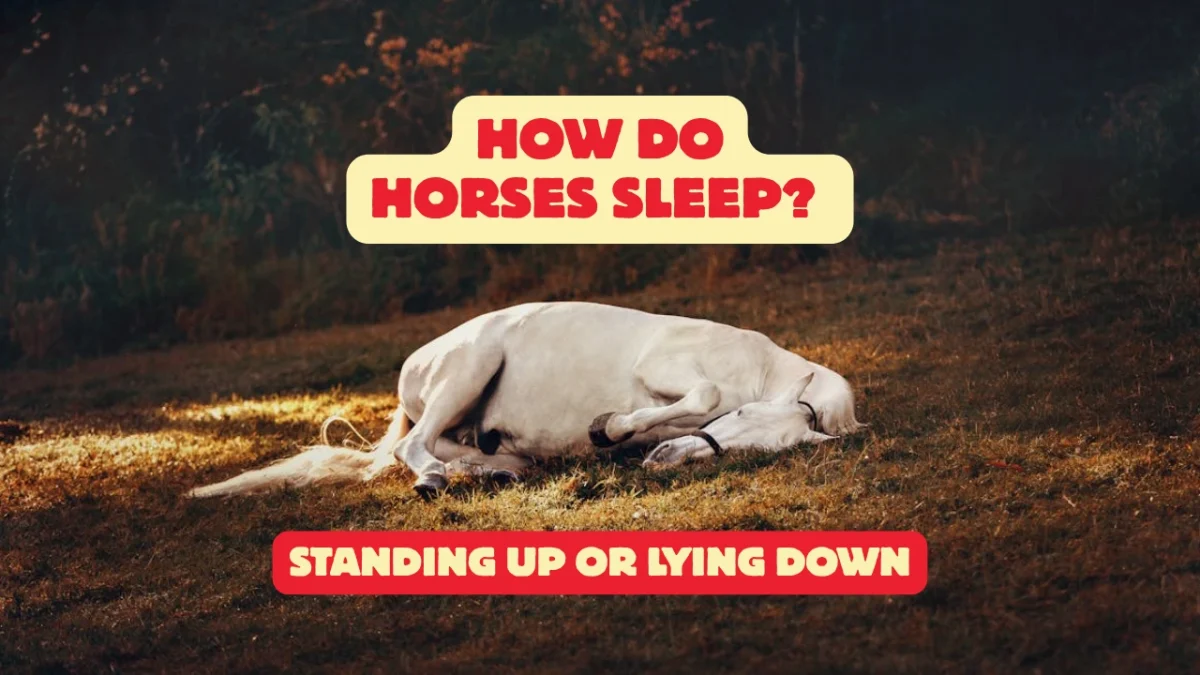
If you have ever watched a horse standing quietly in a field with drooping eyes and a relaxed posture, you may have wondered is that horse actually sleeping. The answer is yes, and the way horses sleep is one of the most fascinating and misunderstood topics in the animal world.
So, how do horses sleep? The short answer is: both standing up and lying down depending on how deeply they need to rest. Understanding the full picture requires a closer look at their biology, behavior, and daily sleep patterns.
Key Takeaways
- Horses sleep both standing up (light sleep) and lying down (REM sleep) — both are essential
- The Stay Apparatus is the biological mechanism that makes standing sleep possible
- REM sleep requires lying down — a horse that never lies down is not getting complete, restorative rest
- Horses are polyphasic sleepers — they rest in many short episodes across the full 24-hour cycle
- Total daily sleep is only 2.5 to 3 hours, with just 30 to 60 minutes of that being deep REM sleep
- A safe, social, comfortable environment is the single most important factor in healthy equine sleep
- Pain, injury, and environmental stress are the leading causes of sleep disruption in domestic horses
Do Horses Sleep Standing Up?
Yes, horses are fully capable of sleeping while standing upright, and they do so for the majority of their rest time. This is not just a quirky habit it is an evolutionary survival mechanism developed over thousands of years as prey animals in the wild.
Horses need to be able to detect predators and flee at a moment’s notice. Lying flat on the ground takes time to get up from; this could cost a horse its life in a dangerous situation. Standing sleep allows them to stay alert while still getting rest.
Just because a horse is standing still with its eyes closed or half-closed does not mean it is in a deep sleep. Horses spend the majority of their standing rest in light sleep stages only not full, restorative REM sleep.
Why Horses Can Sleep Standing Up
The biological secret behind a horse’s ability to sleep standing up is called the Stay Apparatus. This is a unique system of muscles, tendons, and ligaments in the horse’s legs that mechanically locks the limbs in place without requiring any active muscle effort from the horse.
In the front legs, the shoulder, elbow, and knee joints lock together through a passive tendon structure, holding the horse upright with zero strain. In the hind legs, the kneecap (patella) hooks over the femur bone, which simultaneously locks the hock joint — a mechanism known as passive reciprocal locking.
When the horse is ready to move again, it consciously releases the patella and the legs unlock immediately. This means a horse can go from deep drowsiness to a full gallop in a matter of seconds something no other large animal can match.
Do Horses Lay Down to Sleep?
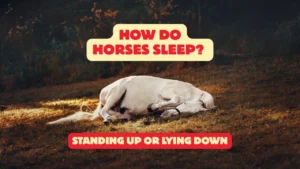
Yes and this part is critical. While horses can and do sleep standing up, lying down is absolutely necessary for complete, healthy sleep. Horses must lie down to achieve REM sleep (Rapid Eye Movement sleep), which is the deepest and most restorative stage of sleep.
During REM sleep, the body’s muscles go into full relaxation — a state called muscle atonia. The Stay Apparatus cannot support this level of relaxation, which is why the horse must lower itself to the ground. Without regular lying-down periods, a horse will eventually develop serious sleep deprivation.
Why Lying Down Is Necessary:
- REM sleep only occurs when lying down
- Full muscle relaxation and tissue repair require a recumbent position
- Brain consolidation and memory function depend on REM cycles
- Foals especially require long periods of lying flat to support rapid neurological development
What’s Unique About a Horse’s Sleeping Habits?
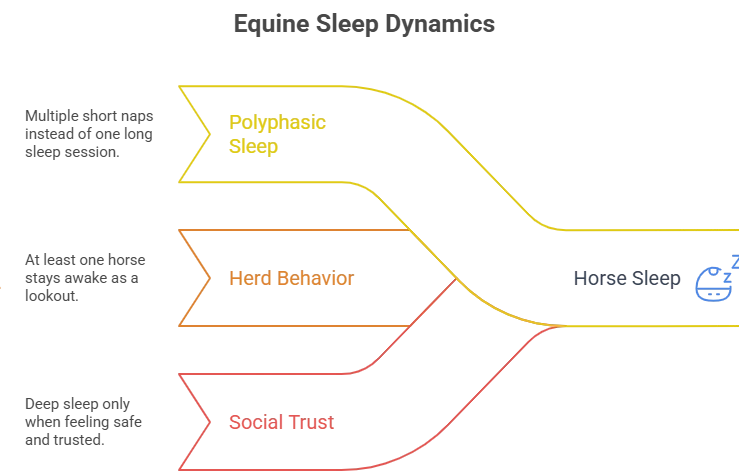
Several things set equine sleep apart from nearly every other animal, including humans. Horses are polyphasic sleepers, meaning they do not sleep in one long continuous block, they take multiple short naps spread across a 24-hour period.
Unlike humans who consolidate sleep into one 7–8 hour session, a horse accumulates its total rest through dozens of brief sleep episodes throughout the day and night. This pattern is deeply tied to their natural herd behavior, where at least one horse always remains awake and alert as a lookout for the group.
Another unique feature is the social trust element in horse sleep. Horses in a herd take turns sleeping, and a horse will only lie down for deep REM sleep when it feels completely safe in its environment. A horse that is isolated, anxious, or in an unfamiliar setting will often avoid lying down altogether sacrificing REM sleep out of self-preservation instinct.
The Three Stages of Equine Sleep
Understanding how horses sleep requires understanding the three distinct stages their sleep cycle moves through. Each stage serves a different biological purpose and occurs in a different physical position.
Stage 1 – Drowsiness (Light Rest)
This is the most frequently observed sleep state in horses. The horse stands with its head lowered, eyes partially closed or glazed, lower lip drooping, and one hind leg resting (cocked). Muscle tone is reduced but the horse remains upright through the Stay Apparatus. This stage provides basic rest but does not involve significant brain recovery.
Stage 2 – Slow-Wave Sleep (SWS)
In this intermediate stage, the horse’s brain activity slows significantly and it enters a deeper rest phase. The horse may still be standing, though some horses begin to shift weight or sway slightly. The body begins physical repair processes during this stage — muscle tissue regeneration, immune function support, and hormonal regulation all occur here. Some horses will lie down in a sternal position (resting on their chest) during this stage.
Stage 3 – REM Sleep (Deep Sleep)
This is the most critical stage and the one that requires the horse to be completely lying down — usually flat on its side (lateral recumbency). The horse’s breathing slows, eyes move rapidly beneath the eyelids, and limb twitching or vocalization may occur. This stage typically lasts only 10 to 30 minutes per cycle, but it is essential for cognitive function, emotional balance, and full physical recovery.
Important Note: Horses are vulnerable during REM sleep because they are completely unaware of their surroundings. In the wild, a herd always has at least one standing sentinel horse so others can safely enter REM sleep. Domestic horses require the same sense of security — a stressful or unsafe environment directly reduces the quality and duration of REM sleep.
What a Horse’s Eyes Look Like During Sleep
During light sleep (drowsiness): Eyes are partially open, glassy, and unfocused. The third eyelid (nictitating membrane) may be partially visible at the inner corner of the eye.
During slow-wave sleep: Eyes may be fully closed or still partially open. The facial muscles relax and the overall expression becomes noticeably softer and heavier.
During REM sleep: Eyes are almost always closed. Rapid movement beneath the eyelids is visible if you look closely. The entire body is relaxed and the horse appears completely limp.
Important Note: If you notice a horse’s eyes are open but the horse is unresponsive to normal stimuli like your voice or movement nearby, it is likely in a standing sleep state. Approach gently, a horse startled suddenly from sleep can react defensively out of pure instinct.
Do Horses Sleep With Their Eyes Open?
Yes horses frequently sleep with their eyes partially or even fully open, particularly during the light drowsiness stage. This is another evolutionary adaptation that allows them to maintain visual awareness of their surroundings even while resting.
Horses have a wide field of vision and can detect movement with very little direct focus. During light sleep, the eyes may appear glazed, unfocused, or half-lidded while the brain is in a resting state. This can easily be mistaken for a horse being awake and alert by an inexperienced observer.
Horse Daily Sleep Schedule and Pattern
Horses do not follow a simple day-night sleep schedule the way humans do. Their sleep is distributed across the entire 24-hour period in a fragmented, polyphasic pattern that reflects their natural grazing and herd behavior.
In the wild, horses spend up to 16–18 hours per day grazing, which means sleep must fit around continuous movement and feeding. Domesticated horses maintain this same biological rhythm even in a stable environment and their internal clock does not simply switch to a human-style sleep schedule.
How Many Hours Does a Horse Sleep?
Horses sleep approximately 2.5 to 3 hours total per day, but this is divided into many short episodes rather than one continuous block. Of this total, only 30 to 60 minutes consists of true REM sleep — the deep, lying-down stage.
The remaining rest time is split between drowsiness and slow-wave sleep, which can occur while standing. Most horses reach their deepest sleep periods between midnight and 4:00 AM, though they take lighter naps throughout the day as well.
| Sleep Stage | Duration Per Day | Position Required |
| Drowsiness | 1.5 – 2 hours | Standing |
| Slow-Wave Sleep | 30 – 45 minutes | Standing or lying (sternal) |
| REM Sleep | 30 – 60 minutes | Lying flat (lateral) |
| Total | 2.5 – 3 hours | Mixed |
What Is the Ideal Sleep Environment for a Horse?
The quality of a horse’s sleep environment directly determines whether it will lie down for REM sleep or restrict itself to standing rest only. Horses are instinctively cautious about becoming vulnerable, and multiple environmental factors influence their willingness to lie down fully.
Key Elements of an Ideal Sleep Environment:
- Space: The stall or shelter must be large enough for the horse to lie flat comfortably without hitting walls. A minimum of 12 x 12 feet is generally recommended for a standard-sized horse.
- Bedding: Deep, clean, dry bedding (straw or shavings) reduces pressure on joints and encourages lying down. Thin or hard bedding is a common and often overlooked reason horses avoid lying down.
- Safety and familiarity: A horse must feel completely safe in its environment. New stables, unfamiliar smells, or nearby sources of stress can prevent a horse from entering REM sleep for days.
- Companionship: Horses are herd animals and sleep far more soundly when a companion animal — another horse, a donkey, or even a goat — is nearby. Isolation is a significant barrier to healthy sleep.
- Noise and light management: Excessive artificial lighting or loud, unpredictable noise disrupts natural sleep cycles. A calm, dimly lit environment at night encourages deeper sleep.
If your horse shows signs of sleep deprivation including collapsing briefly while standing, unexplained fatigue, irritability, or performance decline, the first thing to evaluate is the sleep environment before assuming a medical cause. Environmental stress is the single most common and most correctable cause of equine sleep problems.
Frequently Asked Questions (FAQs)
How much do horses sleep?
Horses sleep approximately 2.5 to 3 hours per day in total, divided across multiple short rest periods throughout the day and night. Unlike humans, they do not sleep in one continuous block. Of this total, only 30 to 60 minutes consists of deep REM sleep, which requires the horse to lie down completely on its side.
What happens if a horse doesn’t get enough sleep?
Sleep-deprived horses can develop serious physical and behavioral problems. Common signs include sudden partial collapse while standing (the horse’s legs buckle briefly before it catches itself), increased irritability, reduced performance, weakened immune function, and difficulty concentrating during training. Chronic sleep deprivation is often caused by pain, environmental stress, social isolation, or an underlying medical condition and should always be assessed by a veterinarian.
Do horses dream when they sleep?
It is widely believed that horses do dream, particularly during REM sleep. During this stage, horses often display visible signs associated with dreaming rapid eye movements under closed eyelids, twitching of the legs or muzzle, soft vocalizations, and changes in breathing rhythm. While scientific confirmation is difficult to obtain, horses share the same neurological structures associated with dreaming in other mammals, making it highly likely.
How long do horses sleep per day?
Adult horses sleep between 2.5 and 3 hours per day on average, though this varies by age, health, and environment. Senior horses or horses recovering from illness may sleep slightly more. Foals sleep significantly more up to 12 hours per day as deep REM sleep plays a critical role in early brain and neurological development.
What is the ideal sleep environment for a horse?
An ideal sleep environment includes a spacious, clean, and deeply bedded stall or shelter where the horse can lie flat without restriction. The horse should have access to a companion animal, a familiar and low-stress setting, and a calm, dimly lit area at night. Horses sleep most soundly when they feel safe, socially secure, and free from pain or environmental disturbances.
Can pain or injury stop a horse from sleeping properly?
Yes, pain is one of the most common causes of sleep disruption in horses. Conditions such as laminitis, arthritis, colic, back pain, and hoof injuries make lying down and rising extremely difficult and uncomfortable. As a result, affected horses often avoid lying down entirely, which eliminates REM sleep from their cycle. This creates a damaging cycle where chronic pain causes sleep deprivation, and sleep deprivation in turn slows recovery and weakens the immune system. Any horse showing signs of disrupted sleep alongside behavioral changes should be examined by a veterinarian for underlying pain conditions.
Can horses develop narcolepsy or sleep disorders?
Yes, horses can develop narcolepsy — a neurological sleep disorder that causes sudden episodes of extreme muscle weakness or complete collapse, typically triggered during moments of drowsiness or relaxation. It is more commonly observed in young foals but can affect adult horses as well. Diagnosis requires a full veterinary neurological evaluation. In confirmed cases, medications such as imipramine may be used to manage episodes. Other equine sleep disorders include idiopathic hypersomnia and sleep deprivation collapse syndrome, both of which require professional veterinary assessment.
Are there safe medications to help a horse sleep or relax?
Medications for equine sedation such as acepromazine, detomidine, or xylazine are used by veterinarians in specific clinical situations like surgical preparation or injury treatment, not for routine sleep support. For horses experiencing sleep-related anxiety or stress, veterinarians typically recommend addressing environmental and social factors first. Supportive options such as magnesium supplementation or veterinarian-approved herbal calming supplements are sometimes considered before any pharmacological approach. Never administer sedative medications to a horse without direct veterinary guidance.
Veterinary Disclaimer:
The information in this article is intended for general educational purposes only. It does not replace professional veterinary advice. Always consult a licensed equine veterinarian for any diagnosis, treatment, or health concerns related to your horse.