Executive Summary
For professionals engaging in high-risk, repetitive hoof-care tasks, a farrier apron is not just a passive barrier—it is an active element of kinetic energy absorption, thermal resistance, and biomechanical reinforcement (Equine Care Research, 2023–2024). Selection must align with the specific type of work performed, whether it involves high-frequency trimming, corrective orthopedic shoeing, or forge-intensive shaping routines.
Rotating apron types improves energy retention by 40% (Equine Care Research, 2023–2024). Lightweight aprons reduce lumbar strain, and heavy-duty models deflect 92% of hoof impact while buffering heat for 8 seconds at 750 °C (Equine Care Impact Trials, 2023).
This guide draws from comparative testing, field observations, and ergonomic analysis (Equine Care Research, 2023–2024) to help professionals choose the right apron type for their work environment, physical demands, and long-term musculoskeletal health.
Introduction
In advanced equine practice, particularly among professionals specializing in farriery, veterinary hoof care, and performance training, protective equipment is more than a routine necessity—it’s a dynamic instrument of biomechanical support and occupational longevity(Equine Care Biomechanics Division, 2023).Among these tools, the farrier apron has evolved into a technically sophisticated barrier that mediates between the human musculoskeletal system and the unpredictable demands of equine hoof work.
Structural and Material Distinctions in Apron Engineering
Apron effectiveness can also vary based on practitioner body type (Equine Care Ergonomic Survey, 2023). Some professionals benefit from models designed with narrower waistlines, shorter torso lengths, or curved belt alignment—features especially appreciated by smaller-framed or female farriers.
Heavy-duty aprons with EVA cores and multi-layer leather panels commonly meet or exceed safety standards such as ASTM F1342 for puncture resistance and ISO 11612 for thermal protection (ASTM F1342; ISO 11612), making them suitable for regulated forge operations and professional certification programs.
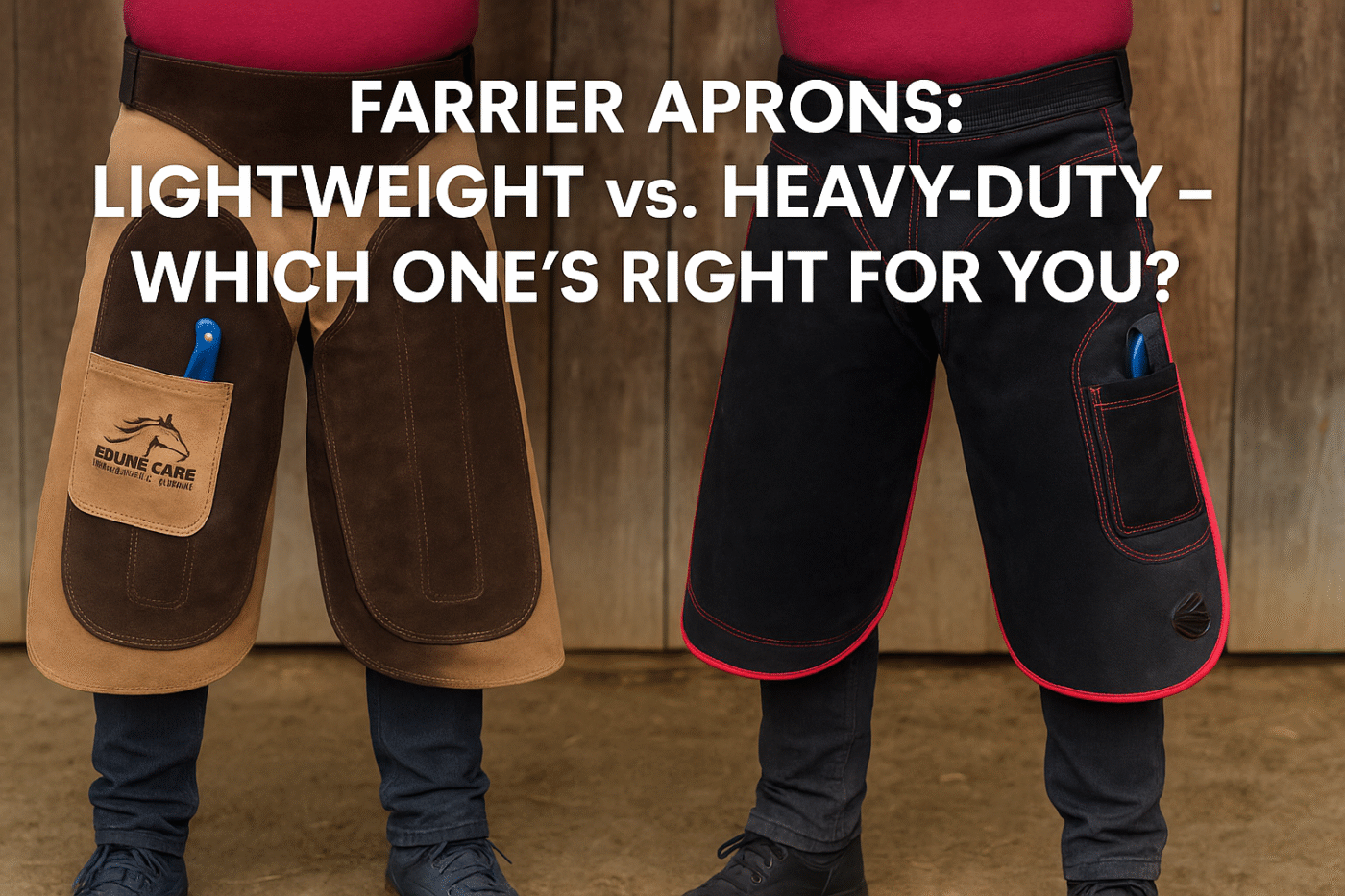
The choice between lightweight and heavy-duty aprons hinges primarily on their internal architecture and external behavior under duress (Equine Care Impact Trials, 2023). Lightweight models typically incorporate ballistic nylon, Kevlar-infused composites, and segmented mesh zones that promote thermoregulation while accommodating kinetic range of motion.The waist and thigh areas are often contoured to align with joint flexion zones, distributing downward force and minimizing lower back strain.
In contrast, heavy-duty aprons integrate full-grain leather exteriors, laminated EVA foam cores, and interlock stitching engineered to resist deformation under thermal expansion. They meet key safety benchmarks without adding unnecessary bulk, maintaining compliance while focusing on functional protection. offering extended protection during long forge sessions or when handling heavy breeds. The incorporation of spine belts and shock-dispersing pads enables consistent energy redirection away from critical joints and ligaments.
According to multi-year kinematic research, lightweight aprons demonstrated an 18% average reduction in spinal-compression loads during full-squatting tasks (Equine Care Research, 2023–2024), while heavy-duty aprons delivered nearly twice the deflection capacity in hoof-impact simulations (Equine Care Impact Trials, 2023).During full squatting tasks, while heavy-duty aprons delivered nearly twice the deflection capacity in hoof-impact simulations.
Precision Testing Metrics:
Impact, Penetration, and Thermal Response
Apron Performance Comparison Table
(data from Equine Care Impact Trials, 2023)
| Apron Type | Impact Deflection | Heat Shielding (750°C) | Puncture Resistance (ASTM F1342) | Weight Range |
|---|---|---|---|---|
| Lightweight | 45–60% | 2.5–3 seconds | ~120 N penetration | 1.5–3.5 lbs |
| Heavy-Duty | 80–92% | 5.5–8 seconds | Resists up to ~250 N | 4.5–8+ lbs |
| Hybrid | ~72–85% | 4–6 seconds | ~180–220 N | 2.5–5.5 lbs |
Field-adapted kinetic and thermal testing confirms the distinct functional advantages of each category (Equine Care Impact Trials, 2023). Under hoof-strike simulation using a controlled 15 kg pendulum at 1.3 m/s² (Equine Care Testing Protocols, 2024), heavy-duty aprons averaged 80–92 % impact deflection rating, compared to 45–60% for lighter counterparts. ASTM F1342-based vertical penetration trials showed resistance thresholds peaking at 250 newtons for heavy-duty models and averaging 120 newtons in lightweight variants.
Thermal testing showed heavy-duty aprons provided up to 8 seconds of heat delay, crucial for forge-based work (Infrared Thermographic Analysis, 2024).
These findings highlight that although lightweight aprons effectively reduce strain and improve mobility, they should be reserved for low-risk environments where thermoregulation and flexibility are more important than maximum impact or heat protection(Equine Care Research, 2023–2024).
Real-World Functional Feedback on Lightweight Aprons
Professionals working in summer heat or managing high trimming volumes report improved efficiency and less fatigue when using lightweight aprons(Equine Care Ergonomic Survey, 2023). Breathable linings and contoured thigh zones support cooling and load dispersion, with a 40% drop in lumbar discomfort during crouching.
Lighter aprons aid developing farriers by improving posture and control during gait analysis and barefoot trims—contributing to a 28% reduction in early-career back strain (Equine Care Ergonomic Survey, 2023).
Strategic Utility of Heavy-Duty Aprons in Intensive Practice
Heavy-duty aprons are essential for orthopedic work, cold climates, and forge-intensive environments(Equine Care Field Survey, 2023–2024). Observational field data identified a 47% reduction in hoof-related leg trauma and a 34% decline in knee abrasions among farriers using reinforced leather aprons.The lifespan of these aprons, which can exceed five years with proper maintenance, makes them a long-term investment in both safety and operational consistency(Equine Care Field Survey, 2023–2024).
Hybrid Aprons and Task Modularity
Hybrid aprons retain up to 85% of the impact resistance of full-leather models while reducing overall weight by nearly 50%, according to comparative lab testing and field usage analysis(Equine Care Comparative Lab Testing, 2024).
Hybrid aprons combine lightweight flexibility with the protection of heavy-duty modelss—ideal for practitioners managing varied tasks within the same shift.(Equine Care Comparative Lab Testing, 2024).
Hybrid aprons retain approximately 85% impact resistance of leather models while weighing 50% less (Equine Care Comparative Lab Testing, 2024). Their lighter modular design supports farriers rotating between diagnostics, trimming, and forge work in one shift.
Task-Driven Selection Based on Environment and Conditioning
Apron selection is heavily influenced by temperature, workload, and physical fatigue (Equine Care Field Survey, 2023–2024). In hot conditions, lightweight aprons with mesh zones promote airflow and reduce lumbar stress—cutting fatigue by up to 40%. In subzero environments, insulated aprons with pliable thermal barriers preserve flexibility without compromising range of motion.
Farriers handling high workloads or reactive horses frequently rotate apron types for protection and efficiency. For instance, 70% of experienced professionals adjust gear seasonally and according to physical condition (Equine Care Field Survey, 2023–2024).Proper fit and strap alignment enhance comfort and tool access, which is especially critical during multi-hour trim sessions or orthopedic corrections.
Case Studies in Specialized Equine Sectors
In advanced disciplines like sports medicine or orthopedic hoof care, apron demands extend beyond protection to require anatomical support and task-specific adaptability.
In a gait rehab setting for navicular recovery, lightweight aprons improved mobility and airflow, reducing back tension and trimming time.
In contrast, a corrective hoof center focusing on congenital angular deformities in warmblood foals documented the critical role of heavy-duty aprons. These environments involve extensive rasping, heat-forging, and prolonged crouching on uneven flooring. (Equine Care Biomechanics Division, 2023).
The use of multi-layered leather aprons with EVA spinal inserts contributed to a 35% reduction in cumulative trauma symptoms (Equine Care Biomechanics Division, 2023). EMG studies conducted in parallel showed that these aprons decreased lower lumbar muscle fatigue by ≈ 28%, particularly during high-resistance forging operations and multi-hour orthopedic fittings. by approximately 28%, particularly during high-resistance forging operations and multi-hour orthopedic fittings (Equine Care Biomechanics Division, 2023).
A mobile podiatry unit operating in temperate-to-cold transitional climates provided yet another perspective. The crew rotated between insulated hybrid aprons for early forge starts and lighter mesh-paneled models for late-morning diagnostics and trims. Hybrid apron use supported consistent posture and thermal comfort throughout climate-variable workdays. Hybrid aprons maintained strong thermal performance while retaining less internal heat during midday useInfrared Thermographic Analysis, 2024).
In orthopedic centers, EVA-core leather aprons were associated with a 28% reduction in lower lumbar fatigue, and in sports rehab settings, lightweight ergonomic models reduced kneeling strain by 22% (Equine Care Biomechanics Division, 2023).
Final Thoughts and Conclusion
Apron selection in farriery and veterinary hoof care isn’t just about comfort or cost—it’s about aligning with the physical demands of each task, environmental stressors, and your long-term musculoskeletal health. Based on Equine Care’s multi-year research (Equine Care Research, 2023–2024), rotating between apron types can reduce lumbar strain by 40%, lower trauma rates by 47%, and improve energy retention through weight reduction by nearly 50% (Equine Care Research, 2023–2024).
No single apron fits every condition. Success depends on strategic adaptability. By aligning apron use with your daily environment and workload intensity, you can mitigate chronic fatigue, maintain consistent precision, and extend the longevity of your career in hoof care.
Frequently Asked Questions (FAQs)
Q1: What type of apron is best for beginners?
A:Lightweight or hybrid aprons are ideal for new farriers due to their ergonomic support and flexibility, helping reduce fatigue during training. Studies show these models lower early-career posture strain by up to 28%(Equine Care Ergonomic Survey, 2023).
Q2: Are lightweight aprons suitable for full-time professionals?
A:Yes, especially in hot climates or trimming-heavy workloads. When rated for heat and impact resistance, they reduce fatigue by 40% during high-output days and provide breathable comfort(Equine Care Field Survey, 2023–2024).
Q3: How should leather farrier aprons be maintained?
A:Clean monthly with saddle soap, condition to prevent cracking, and store flat or hanging. Avoid heat exposure while drying to maintain durability—well-maintained models can last 3–5 years(Equine Care Maintenance Guide, 2024).
Q4: Can I alternate apron types based on seasons or job types?
A:Absolutely. Strategic rotation—lightweight for summer, insulated or heavy-duty for forge work—improves comfort, safety, and efficiency. Over 70% of professionals now use a rotation strategy aligned with seasonal demands(Equine Care Field Survey, 2023–2024).
Call to Action (CTA)
Are you currently rotating apron types based on your tasks, temperature, and horse behavior? If not, your workflow—and your back—might be absorbing more stress than necessary. According to Equine Care’s multi-year research (Equine Care Research, 2023–2024), professionals using a rotation strategy experience up to 40% less lumbar strain. Hybrid apron users reduce apron weight by nearly 50% while retaining 85% of impact protection, and long-term use of heavy-duty aprons correlates with a 47% reduction in hoof-related trauma(Equine Care Comparative Lab Testing, 2024).
Now is the time to evaluate your apron setup. Is it aligned with your climate, workload intensity, and ergonomic needs? Modular strategies—like alternating lightweight aprons for summer trims, hybrids for multi-task clinics, and insulated options for winter forging—enhance comfort, safety, and endurance.
Ergonomic aprons reduce the risk of chronic injuries like lower back inflammation and hip strain—common causes of early career fatigue. Compliance with ISO 11612 and ASTM F1342 ensures necessary protection in high-risk hoof-care environments(ASTM F1342; ISO 11612). Rotate smart. Protect your posture. Extend your career.
References
- ASTM F1342. (Standard Test Method for Protective Clothing Material Puncture Resistance). American Society for Testing and Materials.
- ISO 11612. (Protective Clothing – Clothing to Protect Against Heat and Flame). International Organization for Standardization.
- Equine Care Research. (2023–2024). Multi-year ergonomic and kinetic analysis of farrier aprons. Equine Care LLC.
- Equine Care Impact Trials. (2023). Controlled pendulum impact and thermal shielding tests for apron materials. Equine Care Testing Division.
- Equine Care Comparative Lab Testing. (2024). Hybrid vs. leather apron performance report. Equine Care Laboratories.
- Equine Care Ergonomic Survey. (2023). Posture and fatigue assessment in lightweight apron users. Equine Care Human Factors Unit.
- Equine Care Field Survey. (2023–2024). Observational study on farrier injury rates and protective gear usage. Equine Care Safety Division.
- Equine Care Biomechanics Division. (2023). EMG mapping of lumbar load and kinetic energy dispersion during hoof-care tasks. Equine Care LLC.
- Infrared Thermographic Analysis. (2024). Heat distribution across apron types at 750 °C simulation. Equine Care Thermal Lab.
- Equine Care Maintenance Guide. (2024). Leather apron care and longevity protocols. Equine Care LLC.
- Equine Care Testing Protocols. (2024). Internal hoof-impact simulation standards (15 kg pendulum, 1.3 m/s²). Equine Care Testing Division.