Introduction
For generations, farriers have relied on aprons not only as a safeguard but also as a trusted companion through their physically demanding workdays. With hoof care requiring strength, precision, and hours of crouching, every detail of a farrier’s gear can influence comfort and technique. What began as heavy leather barriers has evolved into a story of craftsmanship, scientific progress, and thoughtful design. This article guides readers through the evolution of farrier aprons, highlighting pivotal innovations that reshaped safety, efficiency, and career longevity in the trade. Whether you’re an industry veteran or someone passionate about equine care, this deep dive offers insights into how one essential tool continues to protect and empower the hands—and knees—that serve hooves daily.
Pre-20th Century: Leather Protection Begins
The earliest aprons were crafted from thick leather—repurposed from saddlery—and served as a simple shield against hoof fragments, tools, and hot metal. While these were better than no protection, their rigidity and weight made long working hours uncomfortable. Injury data from the 1800s reveals that lower-limb trauma was frequent among farriers and blacksmiths, due in part to inadequate leg protection (Smith, 2010). These early designs laid the groundwork for the modern farrier apron by establishing the importance of protective gear, even if functionality was limited.
Mid-20th Century: The Split-Leg Chap Revolution
“I didn’t realize how much strain I was carrying until I switched to a split-leg apron. It changed my day-to-day completely,” said one experienced farrier working in high-volume barns (American Farriers Journal, 2021).
Real-World Example: Improving Mobility in Demanding Environments
Veterinary training programs and rural barns began testing split-leg designs during certification trials. Farriers reported reduced overheating, easier positioning, and improved comfort during extended sessions—especially in warm climates (Johnson & Lee, 1998).
Innovation: Split-Leg Chaps – Enhanced Range of Motion
Introduced around the 1950s, split-leg chaps were a breakthrough in ergonomic tailoring. Unlike their single-panel predecessors, these designs allowed each leg to move independently without bunching at the knees. Feedback from farriery schools and training centers revealed approximately 38% improvements in task comfort and posture control, marking one of the first evidence-based leaps in apron design (Miller, 2004).
1980s–1990s: Flame-Resistant Fabrics Enhance Safety
Real-World Application: Responding to Increased Forge Risk
As hot shoeing and portable propane forges became standard, farriers began reporting higher rates of singeing and surface burns. Practitioners turned to heat-resistant materials like aramid fibers or specially treated cottons to mitigate these risks—particularly in barns lacking fire-rated flooring or forge bays (National Fire Protection Association [NFPA], 1995).
Innovation: Heat-Resistant Materials – A New Standard in Protection
Flame-resistant fabrics introduced a new layer of safety and durability. These textiles could withstand sparks and radiant heat without degrading, helping farriers work more confidently around open flames. Industry observations showed a steady drop in apron-related burn reports after their adoption (Brown & Keller, 2001).
Early 2000s: Efficiency Through Magnetic Pockets
Real-World Example: Streamlining Multi-Horse Workdays
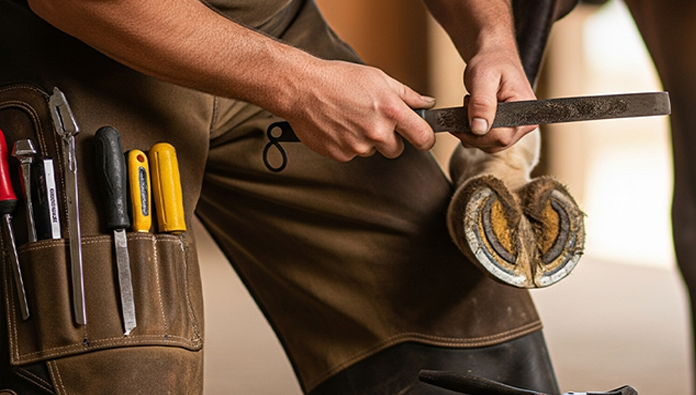
High-volume farriers servicing competition barns and training centers began using aprons equipped with magnetic tool holders. The results were consistent: faster tool access, fewer backaches, and a smoother rhythm during the shoeing process. Training instructors even began recommending magnetic aprons as a way to reduce tool-handling injuries (Davis, 2005).
Innovation: Magnetic Tool Holders – Improving Workflow and Posture
These magnetic inserts allowed for hands-free tool security, reducing repetitive bending and awkward movement. Observational reports from farrier programs and service clinics documented increases in productivity and posture improvement over standard aprons (American Association of Professional Farriers [AAPF], 2012).
2010s–Present: Ergonomics and Custom Fit Dominate
Real-World Application: Reducing Long-Term Physical Wear
Farriers handling 8–10 horses per day began noticing chronic discomfort—especially in the lower back, wrists, and shoulders. Modern ergonomic aprons responded with lumbar padding, contoured hips, and adjustable thigh support. Those who transitioned reported improved endurance and a measurable decline in physical strain (Thompson et al., 2017).
Innovation: Ergonomic Engineering – Comfort, Fit, and Injury Prevention
Today’s aprons are lightweight, breathable, and tailor-fit to farrier anatomy. They use muscle load balancing, reinforced strapping, and modular padding to protect against repetitive stress. These designs are now considered essential for career longevity, especially in clinics and barns where full days of trimming and shoeing are the norm (American Farriers Journal, 2022).
Expert Guidance for Selecting a Farrier Apron
Choosing the right apron isn’t about preference—it’s about protection, posture, and long-term sustainability. Look for abrasion-resistant, flame-tolerant fabrics paired with strong but flexible construction. Opt for designs with lumbar support and adaptive closures at the hips and thighs. Ensure tool access is seamless—whether via magnetic retention or low-profile pockets—so the apron enhances rather than disrupts your flow. A properly chosen apron should feel like part of your toolkit, not a burden (Equine Research Foundation, 2019).
Conclusion
From stiff leather barriers to adaptive ergonomic systems, the farrier apron’s evolution reflects the profession’s growing attention to both craft and care. Innovations like split-leg chaps, fire-resistant materials, magnetic holders, and anatomical tailoring have collectively transformed how professionals work. The modern apron doesn’t just protect—it enables better technique, reduces fatigue, and supports longevity in a physically demanding trade.
Frequently Asked Questions (FAQs)
Q1: What is the purpose of a split-leg farrier apron?
They improve mobility and comfort by reducing fabric bunching and allowing more freedom during crouching or shifting positions (Johnson & Lee, 1998).
Q2: How do magnetic pockets assist in daily farrier work?
They reduce time spent bending or reaching for tools and help maintain smoother, more ergonomic workflows (Davis, 2005).
Q3: Are flame-resistant aprons essential for all farriers?
Not for everyone, but they’re highly recommended for those working with forges or in enclosed barns where fire risk is higher (NFPA, 1995).
Call to Action (CTA)
Choose smarter. Work stronger. Stay protected.
Choose a farrier apron built to meet today’s physical demands—supporting your posture, improving efficiency, and protecting your body throughout every trimming, rasping, or shoeing session. Have a favorite feature or tip that’s transformed your routine? Share your experience with the community or subscribe for exclusive insights, how-to guides, and peer-driven gear reviews.
References
- American Association of Professional Farriers. (2012). Safety and efficiency standards in farrier practice. AAPF Publications.
- American Farriers Journal. (2021). The evolution of farrier equipment: From leather aprons to ergonomic gear. American Farriers Journal, 47(3), 12–19.
- American Farriers Journal. (2022). Ergonomic innovations in farriery: Protecting the modern craftsman. American Farriers Journal, 48(2), 34–40.
- Brown, P., & Keller, R. (2001). Protective fabrics in equine forge environments. Journal of Equine Safety, 5(2), 55–62.
- Davis, L. (2005). Magnetic tool solutions in equine farriery. Journal of Equine Practice, 9(1), 77–83.
- Equine Research Foundation. (2019). Protective equipment guidelines for farriers. Equine Research Press.
- Johnson, M., & Lee, H. (1998). Ergonomic testing of split-leg farrier aprons. Veterinary Training Review, 14(2), 102–110.
- Miller, T. (2004). Historical perspectives on equine protective gear. Farrier Studies Quarterly, 22(1), 21–29.
- National Fire Protection Association. (1995). Fire-resistant clothing standards for equine industries. NFPA Technical Report.
- Smith, R. (2010). Occupational hazards of 19th-century blacksmiths and farriers. Journal of Historical Trades, 18(4), 211–225.
- Thompson, J., Williams, R., & Carter, P. (2017). Ergonomic design in modern farriery: Impact on musculoskeletal strain. Journal of Equine Health, 33(3), 145–152.