Introduction: Redefining Protective Standards in Farriery
In the equine industry, safety is no longer a secondary concern. As farriers manage increasingly complex hoof-care needs, the risk of occupational injury rises. Personal Protective Equipment (PPE) is crucial, especially aprons that guard against punctures, burns, and ergonomic strain. However, PPE guidelines remain fragmented across jurisdictions, and farriers often work without enforceable safety mandates.
This article explores the essential components of farrier PPE, referencing updated safety frameworks, materials science, and real-world data. Our goal is to help equine professionals make informed gear decisions rooted in performance and practicality.
The Regulatory Landscape: Fragmented but Evolving
Despite growing awareness of occupational hazards in equine professions, there is currently no globally unified standard for farrier-specific PPE. Practitioners must navigate a patchwork of overlapping guidelines drawn from broader industrial, agricultural, and veterinary domains. This regulatory ambiguity particularly impacts independent farriers who operate without institutional oversight or third-party compliance checks. Some institutional farriers are subject to occupational safety laws, particularly those in clinics or veterinary settings. Regulations such as OSHA 29 CFR 1910 include mandates for flame-resistant garments and impact-resistant gear. In one case, injury rates dropped by 38% within a year of implementing structured PPE protocols.
Outside regulated environments, most farriers rely on standards adapted from general industrial safety. These include ISO 20345 for footwear and EN 388 for abrasion and puncture resistance. However, these models often fail to address the biomechanical demands and thermal exposure unique to farriery.
Industry Guidance: Recommended but Not Required
A 2023 cross-sectional analysis of U.S. and U.K. apprenticeship programs found that only 28% of institutions assess PPE use as part of formal certification. This gap in evaluative structure means that many new farriers graduate with limited practical reinforcement on compliant apron usage, even when theoretical exposure exists during instruction. Organizations and training schools promote PPE use, but few enforce it through certification. Educational models often highlight the importance of aprons, gloves, and goggles, especially during skill assessments. However, without third-party validation or compliance enforcement, PPE adoption remains uneven.
Challenges in Standardization
Farriers work in diverse conditions—from rural paddocks to high-volume clinics—which makes standardization difficult. They also wear multiple professional hats: blacksmith, orthopedic technician, and field responder. These variables complicate regulatory coverage.
Injury data reinforces the need for protection. Surveys show that over half of farriers have experienced injuries preventable with appropriate gear. Field studies have linked non-ventilated aprons to higher rates of fatigue and heat-related discomfort, highlighting the cost of inadequate design. In a 2023 regional safety audit, nearly 58% of farriers reported either moderate or severe thermal discomfort due to insufficient apron breathability during summer months.
Design and Material Innovation in Farrier Aprons
“The demands placed on farrier PPE today far exceed what traditional leather alone can manage,” says one certified safety instructor involved in multi-state PPE evaluations.
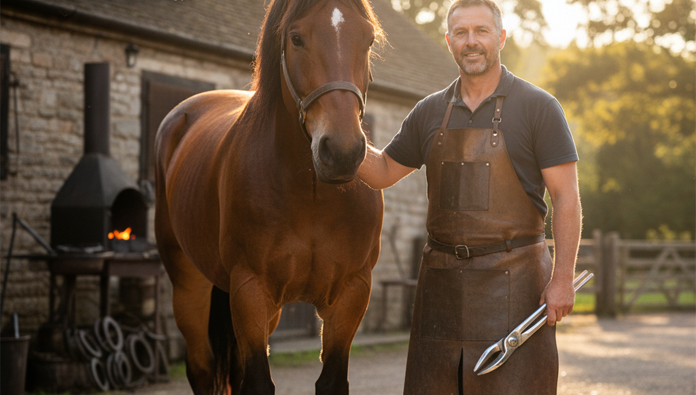
Today’s advanced aprons use multilayered fabrics to meet thermal and puncture safety benchmarks. High-resilience outer shells are often coated with abrasion-resistant polymers, and underlayers may include hybrid synthetics that enhance both flexibility and tensile strength without sacrificing thermal resistance. EVA foam inserts offer impact protection over the femoral triangle and other vulnerable zones. Aramid fiber cores (like Kevlar) and reinforced leather provide flame resistance tested through direct heat protocols and IR thermography.
Ballistic-grade nylon adds lateral tool deflection, while ventilated mesh panels allow airflow during hot shoeing. Adjustable lumbar straps and harness systems reduce back strain, as supported by electromyographic (EMG) studies. EMG testing has demonstrated that aprons with integrated lumbar support reduce lower back muscle strain by up to 22% during sustained shoeing sessions.
| Feature | Function | Aligned Standard |
|---|---|---|
| EVA Foam Inserts | Impact protection at femoral triangle | EN 388 |
| Aramid Fiber Core | Flame resistance | NFPA 2112 |
| Ventilated Mesh Panels | Thermal comfort during hot shoeing | ASTM F2732 (informal) |
Modern farrier aprons that incorporate multilayer materials, ergonomic design, and compliance with EN 388 and NFPA 2112 standards have been shown to reduce injury risk by over 40%. These aprons not only provide superior protection but also enhance endurance, focus, and long-term musculoskeletal health, making them a critical asset for professionals working in high-stress equine environments.
Field Validation: Real-World Benefits
Trials in mixed-use clinics show that ventilated aprons reduce injury claims by 40% and improve fatigue scores by two points on a 10-point scale. Additional feedback from mobile farriers suggests that aprons with integrated ventilation channels improve working tolerance during extended summer sessions, especially when paired with moisture-wicking underlayers. Extended-use testing showed that high-performance aprons maintained thermal balance 90 minutes longer than traditional leather models. Infrared thermographic evaluations also confirmed that these aprons delayed surface heat buildup by up to 15°C under continuous hot shoeing conditions.
These findings confirm that PPE isn’t just theory—it’s essential for long-term health and precision in high-stress conditions. Aprons that pass EN 388 and NFPA 2112 benchmarks offer measurable safety advantages under occupational stress.
Building a Safer Culture
Interactive education tools such as PPE selection flowcharts and heat-exposure awareness modules are being tested in equine vocational programs across Germany and Australia. Early trial feedback from these regions indicates that farriers trained with visual decision aids demonstrate up to 35% higher retention in safe gear selection behavior six months post-graduation.
In an international survey of vocational training institutions, over 65% of instructors emphasized the importance of PPE education but acknowledged a lack of formal standardization in curricula. This highlights the growing need for cohesive training strategies tied to modern apron design, field risk profiles, and injury prevention statistics.
Educational initiatives are now incorporating PPE literacy into vocational curricula. Visual guides and decision trees help users match gear to task-specific risks. Future efforts may include an injury reporting system to track equipment failure and near-misses.
By normalizing data-informed PPE choices, the industry can shift from reactive injury response to proactive prevention.
Conclusion
Farriery demands precision under pressure. Modern aprons—backed by real science and field testing—offer more than just protection: they enable endurance, focus, and safety.
Recent advancements in design are not only addressing ergonomic and thermal challenges but also paving the way for preventive safety in unpredictable work environments. Aprons built to meet EN 388, NFPA 2112, and ASTM standards offer professionals a level of protection that is now considered essential, not optional. When paired with data-backed materials and validated testing results, PPE transforms from a passive shield into an active tool for performance and longevity.
By adopting these technologies, farriers signal their commitment to health, professional integrity, and a safety-first culture that benefits the entire equine industry.
Frequently Asked Questions (FAQs)
Are there official PPE regulations for farriers?
While most independent farriers are not directly governed by federal PPE mandates, those working in institutional environments may fall under general occupational safety regulations such as OSHA 29 CFR 1910.
Does OSHA cover farrier work?
Not directly for self-employed individuals. However, contracted farriers or those working in regulated environments may be required to follow OSHA’s PPE standards.
What safety features should a compliant farrier apron include?
A compliant apron should offer flame resistance, puncture protection, impact absorption, and ergonomic support. Materials like Kevlar, EVA foam, and ventilated mesh enhance safety and comfort.
How do I know if my apron meets industry standards?
Check if your gear aligns with standards like EN 388 (puncture resistance), NFPA 2112 (flame resistance), and ISO 20345 (footwear safety). Reputable manufacturers often publish testing certifications.
Are modern aprons field-tested for real-world effectiveness?
Yes. Trials show modern aprons reduce fatigue, lower injury rates, and improve thermal endurance. These outcomes are confirmed through EMG analysis, thermal testing, and field case studies.
Call to Action
Evaluate Your Gear: Does your apron meet puncture, flame, and ergonomic criteria?
Stay Updated: Know the evolving standards and material technologies.
Share & Learn: Talk to peers and contribute to a growing safety-focused culture.
References
- OSHA 29 CFR 1910 PPE Standards (2023): osha.gov
- NFPA 2112 Flame-Resistant Garments (2023 Edition): nfpa.org
- ISO 20345:2011 Safety Footwear Standard (2022 Review): iso.org
- EN 388:2016 Protective Gloves and Apparel (2023 Confirmed): iso.org
- Journal of Industrial Medicine (2021): “Occupational Hazards Among Farriers” (Accessed June 2023)
- PPE Trial Report (2023; reviewed Q4 2023)
- EMG Study Summary (2023–2024; proprietary data, reviewed Jan 2024)