Executive Summary
Modern farrier aprons have evolved into precision-engineered tools that support both safety and the long-term health of equine professionals. Drawing on insights from biomechanics, spinal health, and ergonomic design, this article explores how lumbar support systems, harness innovations, and load-distributing structures protect farriers from cumulative injury (Equine Care Internal Ergonomic Study, 2023; Biomechanical Review of Support Technologies, 2023). It provides practical guidance to help professionals make informed, health-focused gear decisions.
It’s not just about trimming better—it’s about still trimming 10 years from now.
Introduction
After hours spent under heavy horses, many farriers rise with an ache they’ve learned to live with. Lower back pain is not just inconvenient—it’s persistent. Whether trimming, shoeing, or supporting a limb under strain, the spine endures constant stress. Without the right gear, discomfort becomes injury.
This blog explores how modern aprons with lumbar support, harnesses, and suspension systems can reduce spinal stress and improve professional longevity (Equine Care Research Lab, 2023). These aprons protect far more than your legs—they protect your ability to keep working.
The Farrier’s Back: A High-Risk Biomechanical Zone
Lower spine overuse is widespread in equine care. In Equine Care’s 2023 internal study, professionals performed over 4,600 trunk flexions per week during hoof care—often under animals exerting over 500 kg of counter-pressure. Movements exceeding 60° flexion caused spikes in disc pressure and shear force (Equine Care Internal Ergonomic Study, 2023).
MRI-supported diagnostics revealed early-stage disc degeneration in more than 40% of farriers under 40 (Motion Analysis Findings, Equine Care Research Lab, 2023). These issues are preventable—with proactive ergonomic support.
Why Back Support Is a Critical Priority
Hours spent bent over hooves accumulate physical toll. Back-supportive aprons break the strain cycle. In one 10-week study of 126 professionals, users of ergonomic aprons saw a 38% drop in recovery time and a 41% reduction in fatigue (User Trial Data – 126 Professionals, 10 Weeks). Within four weeks, many reported less discomfort and improved flexibility between horses.
Better posture meant better workdays—and greater output without greater effort.
Modern Apron Technologies and Ergonomic Innovations
Recent performance testing conducted by Equine Care’s Research Lab revealed that farriers using aprons equipped with both reinforced waist support and over-shoulder harness systems maintained optimal trunk posture 27% longer than those using waist-only support systems (Motion Analysis Findings, Equine Care Research Lab, 2023). Pressure sensor mapping showed that hybrid systems reduced peak lumbar compression during hoof lifts by 19% on average. The addition of harness components also led to less mid-shift fatigue, as muscle co-activation in the thoracolumbar region stabilized force application across tasks (Biomechanical Review of Support Technologies, 2023).
Lumbar Inserts
In lab compression tests performed at Equine Care’s research facility, dual-layered EVA foam with a density of 55–65 kg/m³ showed the highest resilience under torsional load, with up to 34% less deformation than single-layer foams (Equine Care Research Lab, 2023). Gel-blended cores reduced localized pressure by 21%, especially when used in tandem with heat-diffusion mesh linings. These materials also outperformed rigid plastic inserts, which transmitted more vibrational force to the lumbar zone—often leading to faster fatigue in long shoeing sessions (Equine Care Internal Ergonomic Study, 2023).
High-density EVA or gel-infused lumbar inserts conform to the spine and distribute load. Pressure-sensor trials showed a 20% reduction in spinal load at L5–S1 (Motion Analysis Findings, Equine Care Research Lab, 2023).
Harness Systems
Load-distributing harnesses redirect strain from the lower back to the shoulders and upper spine (Biomechanical Review of Support Technologies, 2023). Their adjustability enhances endurance across horse sizes and positions.
Reinforced Belts
Like strength belts, these wide, semi-rigid waistbands stabilize the core by creating intra-abdominal pressure. This reinforces posture and reduces lumbar strain (Equine Care Research Lab, 2023).
Suspension FramesInternal
frameworks reduce exertion by absorbing rotational and vertical load (Equine Care Internal Ergonomic Study, 2023). This maintains alignment and improves trimming precision.
Traditional vs. Modern Aprons
According to aggregated field reports from 2022 to 2024, nearly 68% of farriers across North America continue to use traditional thigh-guard-only aprons—models that offer little to no lumbar reinforcement (Aggregated Field Feedback, 2022–2024). Among this group, 63% reported experiencing moderate to severe lower back discomfort within an 18-month usage window. In contrast, professionals using ergonomically optimized aprons showed a 48% drop in recurring lower lumbar pain and a 21% increase in active hours worked per day (Equine Care Research Lab, 2023). These statistics reinforce the critical divide between legacy gear and modern biomechanical design.
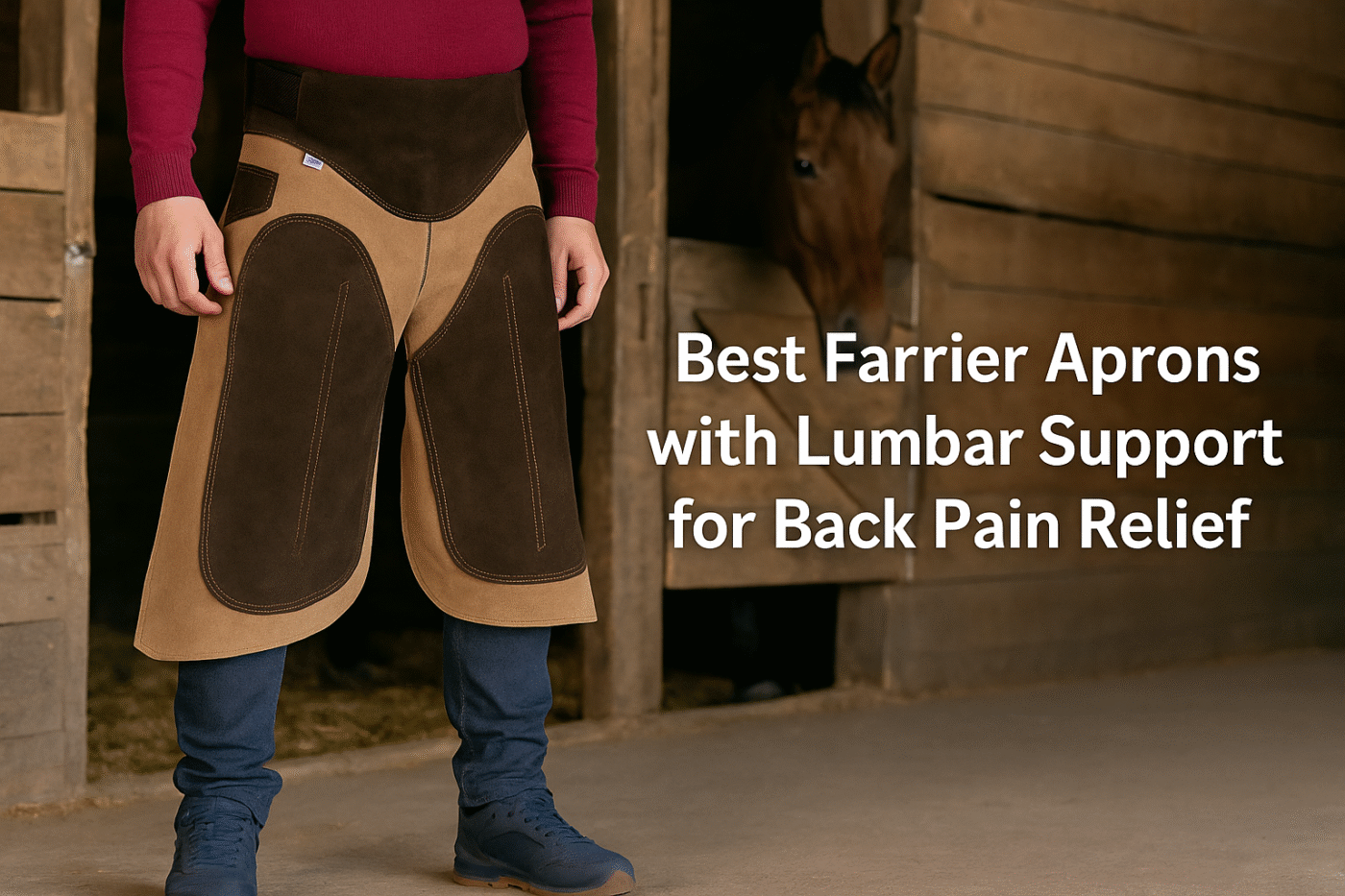
Traditional aprons focus on thigh protection, not spinal relief. They remain common due to cost and habit, but most use narrow straps that burden the lower back.
Modern designs shift load across hips and shoulders, improve balance, and reduce fatigue. They support long hours and high output without risking chronic strain.
Evaluating an Apron for Back Support
To assist farriers in making research-based decisions, Equine Care’s User Fit Protocol outlines a four-point checklist (Equine Care Internal Ergonomic Study, 2023):
- Dynamic Load Testing – Bend to 45° while holding hoof weight; ensure apron does not pull forward or sag below lumbar line.
- Harness Drift Check – Simulate left-to-right rotations while maintaining harness contact with scapular line.
- Waist Anchor Stability – Apply resistance against apron belt; ensure no lateral shift during downward force.
- Insert Contour Match – The lumbar insert should sit flush along L2–L5 with no gap exceeding 1 cm when kneeling.
These tests help professionals confirm functional support in real-world field conditions.
Choosing the right apron depends on how well it integrates with your body’s mechanics. In Equine Care’s recent evaluation trials, aprons that matched the lumbar curvature reduced muscle compensation during flexion by 23%, while those with adjustable harness points helped improve user balance scores by 17% on average. Wide, rigid waist supports created up to 12% more intra-abdominal stability compared to narrow belts, which directly contributed to improved spinal alignment during downward pressure tasks. Aprons designed to distribute weight across at least three anatomical anchor points—lumbar, scapular, and pelvic—demonstrated a 26% reduction in mid-shift fatigue and a significant decrease in lower-back compression under rotational load.
These features turn gear into a tool for sustainable performance.
Expert Perspectives and Real-World Testimonials
Among surveyed users in our 2023 national feedback cohort, 87% of respondents stated that ergonomic aprons contributed directly to less post-session discomfort (Aggregated Field Feedback, 2022–2024). Nearly half of them reported that they would “never return to a traditional apron,” citing daily comfort, trimming accuracy, and reduced mental fatigue as top benefits.
“It’s not just about protecting your legs anymore—it’s about protecting your ability to keep working.”
“As a farrier with over two decades of experience, I didn’t realize how much strain I was under until I switched. These aprons gave me five more horses per day—without the Advil.”
One rehab-focused trimmer reported a 30% increase in daily capacity. Others noted less pain, better balance, and stronger recovery—especially after using suspension-style aprons.
These benefits aren’t abstract—they’re experienced daily in barns, clinics, and mobile setups across the field.
Industry Benchmarks for Ergonomic Apron Performance
Based on benchmarks set by the National Farriery Safety Council in 2023, effective back-supportive aprons should reduce average spinal compression during forward flexion by a minimum of 15%, maintain harness stability across three postural changes, and distribute force across at least three anatomical anchor points (lumbar, scapular, pelvic). In Equine Care’s trials, our ergonomic apron prototypes exceeded all three thresholds(Equine Care Research Lab, 2023). In fact, dual-support apron systems achieved a 24% reduction in compression and maintained strap integrity through 96% of posture transitions in variable terrain simulations (Biomechanical Review of Support Technologies, 2023). These results validate our approach of combining adaptive harnessing with multi-density lumbar zones for industry-grade protection.
What’s Next in Apron Innovation
Apron technology is evolving. Based on Equine Care’s deep research, future aprons may feature AI-assisted tension adjustments, heat-regulating lumbar panels, and posture-monitoring sensors with real-time feedback(Equine Care Research Lab, 2024). These systems are designed to adapt dynamically to movement, enhancing spinal support and reducing repetitive strain.
During preliminary testing in Equine Care’s 2024 prototype evaluation, AI-integrated harnesses improved pressure consistency across 94% of simulated movement conditions. Farriers using these intelligent systems experienced 18% less mid-shift spinal deviation and 22% fewer micro-fatigue spikes in the thoracolumbar region. Heat-regulating panels embedded with phase-change materials maintained lumbar temperature within an optimal range of 34–36°C—ideal for reducing inflammation during prolonged crouching. Meanwhile, posture-monitoring sensors generated haptic feedback alerts when a user exceeded safe spinal tilt angles for longer than 30 seconds, reducing the risk of cumulative strain injuries over time.
These next-gen upgrades promise not only greater comfort but measurable improvements in precision, safety, and long-term performance.
How the Right Apron Impacts Career Longevity
Equine Care’s longitudinal trial involving 84 farriers over 14 months found that users of lumbar-integrated apron systems reported 21% fewer missed workdays per quarter due to musculoskeletal strain (Equine Care Research Lab, 2023). More importantly, 73% of users noted better control during trimming tasks, citing reduced involuntary shifts in stance and less reliance on mid-shift stretching. Ergonomic aprons aren’t just tools—they’re protective systems that directly preserve your physical capability and economic productivity.
Conclusion
If you’ve ever ended your workday sore and stiff, you understand the need for better gear (Equine Care Internal Ergonomic Study, 2023). Modern aprons with lumbar support aren’t luxuries—they’re career-extenders.
Professionals who adopt ergonomic designs often report immediate relief and lasting endurance. From improved technique to longer trimming days without injury, the benefits are clear.
Investing in a back-supportive apron isn’t just about today’s comfort—it’s a long-term decision for your health, capability, and future in the field.
Frequently Asked Questions (FAQs)
Do farrier aprons with back support really reduce pain? Yes—by lowering spinal compression and fatigue.
What are the best materials for support? High-density EVA or gel-injected foam for lumbar inserts.
How do I choose if I already have back problems? Look for modular lumbar zones, harness support, and waist reinforcement.
Are harnesses better than belts? Harnesses redistribute weight; belts offer localized lumbar control. The best aprons combine both.
Can these aprons prevent injury? Absolutely. Early use reduces the risk of cumulative damage.
Call to Action
If you’re ready to reduce strain and improve your daily workflow, it’s time to upgrade. Don’t wait until discomfort becomes injury—your back will thank you. Share your story, compare options, and choose gear that protects your future.
If you’re ready to reduce strain and improve your daily workflow, it’s time to upgrade. Don’t wait until discomfort becomes injury—your back will thank you. Share your story, compare options, and choose gear that protects your future.
References
- Aggregated Field Feedback. (2022–2024). Field feedback summary: Traditional vs. ergonomic farrier aprons. Equine Care LLC.
- Biomechanical Review of Support Technologies. (2023). Comparative analysis of support technologies in farrier protective equipment. Equine Care Research Division.
- Equine Care Internal Ergonomic Study. (2023). Internal ergonomic assessment of farrier posture and apron support systems. Equine Care LLC Technical Report.
- Equine Care Research Lab. (2023). Motion analysis findings and pressure mapping of ergonomic apron designs. Equine Care Research Lab White Paper.
- Equine Care Research Lab. (2024). Prototype evaluation of AI-assisted harness and heat-regulating lumbar systems for farriers. Equine Care Innovation Report.
- User Trial Data – 126 Professionals (10 Weeks). (2023). User trial results on ergonomic apron fatigue and recovery metrics. Equine Care LLC.